

Issue #9341 The Choice, Friday, October 10, 2025
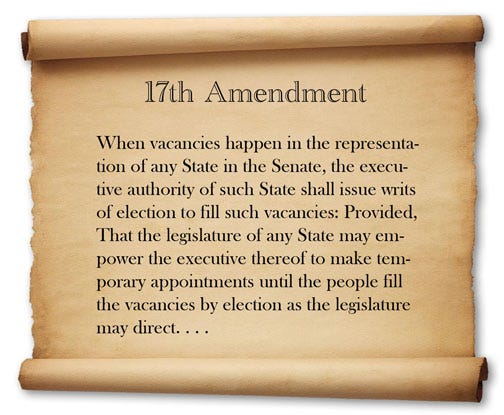
Every Friday until the end of 2025, we will publish a post about each of the 27 Amendments to the Constitution.
As we continue to study the amendments to the Constitution each Friday, we must remember that the current administration is doing everything it can to ignore the Constitution.
The Constitution of the United States, which includes all of the amendments, is the law of this land. The current occupant of the White House believes he can govern by issuing almost weekly executive orders, but executive orders are not laws.
Currently, the #ConvictedFelon in the White House is blatantly ignoring any laws or policies he does not like, as well as ignoring his oath to uphold the Constitution. Specifically, he and members of his administration are disregarding the 1st, 4th, and 5th Amendments.
Understanding the 17th Amendment
Each of the fifty states (but not the territories) is allotted two Senators to represent the state in Congress, irrespective of population.
Ratified on April 8, 1913, the 17th Amendment fundamentally altered the structure of American democracy by changing the election process for U.S. Senators. Before its ratification, senators were chosen by state legislatures. This process was intended to ensure that the Senate would be a body representing the states, providing a balance to the popularly elected House of Representatives.
However, by the late 19th and early 20th centuries, the process was marred by corruption, deadlocks in state legislatures, and a growing disconnect between Senators and their constituents.
The Push for Reform
The Progressive Era, led by President Theodore Roosevelt, was a period marked by social activism and political reform, during which mounting public pressure led to the direct election of senators. Reformers argued that direct elections would reduce corruption and increase accountability, ensuring that senators were more responsive to the public’s needs.
Many politicians were wary of altering the government's foundational structures. However, as public demand intensified and states began conducting non-binding primaries to express their senatorial preferences, the momentum for change became unstoppable.
The Impact of the 17th Amendment
By mandating the direct election of senators, the ratification of the 17th Amendment empowered citizens and aligned the Senate more closely with the public will. This change aimed to reduce corruption by minimizing the influence of political machines and special interests that previously manipulated legislative elections.
The 17th Amendment also helps to ensure that all voices have a direct line of influence in selecting those who would represent them at the highest levels.
Of course, we still elect the president and vice president indirectly through the Electoral College. Hopefully, that will change in the near future.
As we continue to explore each amendment to the U.S. Constitution, let “The Choice” series on the We Are Speaking platform serve as a reminder that your voice plays a crucial role in shaping its future. Subscribers—both free and paid—are encouraged to join the conversation, offering insights and reflections on how past amendments inform our understanding of today’s political landscape.
If you like us, REALLY like us, please click the little heart “Like” button at the top of this post!

Buttons:
Heart: Like Bubble: Comment Arrow Up: Share Arrows Circle: Restack
If you like us, REALLY like us, please click the “Like” button at the top of this post!
Your “Likes” mean a LOT to us! We appreciate your support!
Buy Pam a cup of Colombian Coffee!
Engage with us and our posts on Substack Notes, where we publish new content almost daily.
Our October 2025 subscriber goals are 150 new free subscribers and 75 new paid subscribers! You can help us reach our goal!
We Are Speaking is a reader-supported publication. To receive new posts and support our work, consider becoming a free or paid subscriber.
Follow Pam on Bluesky, the best “X” alternative.
Follow Keith on Bluesky, the best “X alternative.
Independent Authors and Creative Professionals: Check out my valuable books and courses on Branding and Marketing just for you via Pam Speaks 2 You.

