

Issue #945 The Choice, Friday, October 24, 2025
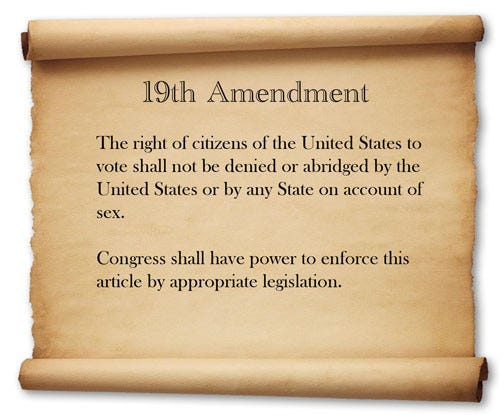
Every Friday until the end of 2025, we will publish a post about each of the 27 Amendments to the Constitution.
The 19th Amendment to the U.S. Constitution, ratified in 1920, prohibits denying citizens the right to vote on the basis of sex, effectively granting women the right to vote. This was the culmination of a decades-long struggle by the women’s suffrage movement. However, discriminatory practices such as poll taxes and literacy tests prevented many women, particularly women of color, from exercising this right until the passage of the Voting Rights Act of 1965.
While the 19th Amendment was a landmark victory, its promise was not immediately extended to all women. Indigenous men and women were not even granted American citizenship until 1924, and discriminatory state laws continued to disenfranchise many women of color until the Voting Rights Act of 1965.
The fight for women’s suffrage began in the mid-19th century with organized efforts such as the Seneca Falls Convention in 1848 and involved generations of activists who employed tactics including protests, lobbying, and civil disobedience.
The Seneca Falls Convention is historically significant because it marked the beginning of a formalized movement to address women’s rights and laid the groundwork for future activism. It was one of the first organized calls for gender equality in the U.S. and helped to ignite a broader white women’s rights movement that would continue throughout the 19th and 20th centuries.
The 1913 Women’s March, also known as the Woman Suffrage Procession, was a pivotal event in the women’s suffrage movement in the United States. It took place on March 3, 1913, in Washington, D.C., one day before President Woodrow Wilson’s inauguration. Organized by suffragist Alice Paul and the National American Woman Suffrage Association (NAWSA), the march demanded a constitutional amendment granting women the right to vote.
Key aspects of the 1913 Women’s March included over 5,000 participants, symbolic clothing and messaging, significant obstacles from hostile onlookers, and impactful media coverage. Despite facing segregation and hostility from men in town for the upcoming presidential inauguration and forcing the members of my Black sorority, Delta Sigma Theta, to walk at the back, the march drew national attention to the suffrage movement. It highlighted the suffragists’ resolve, influenced public support, and set the stage for future actions, eventually leading to the 19th Amendment’s ratification in 1920.
The 1913 Women’s March is remembered as a bold and strategic effort that showcased women's determination to secure the right to vote, forming a crucial part of the ongoing struggle for gender equality in the United States.
The passage of the 19th Amendment in 1920 was not merely a change in voting rights; it laid the foundation for greater women’s participation in every facet of public life. Today, women are not only voters but influential leaders, policymakers, and trailblazers across all sectors.
While the 19th Amendment was a critical victory, the quest for complete gender equality continues. Women in the United States and around the world still face disparities in pay, representation, and opportunity. Challenges such as voter suppression, unequal access to education, and systemic discrimination remain barriers that need to be dismantled.
Today, white women are the greatest beneficiaries of gender equality progress, even as they are also still faced with the same gender-based inequality.
As we celebrate the historic achievement of the 19th Amendment, it is crucial to remain committed to opening more doors for future generations of women.
If you like us, REALLY like us, please click the little heart “Like” button at the top of this post!

Buttons:
Heart: Like Bubble: Comment Arrow Up: Share Arrows Circle: Restack
If you like us, REALLY like us, please click the “Like” button at the top of this post!
Your “Likes” mean a LOT to us! We appreciate your support!
Buy Pam a cup of Colombian Coffee!
Engage with us and our posts on Substack Notes, where we publish new content almost daily.
Our October 2025 subscriber goals are 150 new free subscribers and 75 new paid subscribers! You can help us reach our goal!
We Are Speaking is a reader-supported publication. To receive new posts and support our work, consider becoming a free or paid subscriber.
Follow Pam on Bluesky, the best “X” alternative.
Follow Keith on Bluesky, the best “X alternative.
Independent Authors and Creative Professionals: Check out my valuable books and courses on Branding and Marketing just for you via Pam Speaks 2 You.

