

Issue #902 The Choice, Friday, August 1, 2025
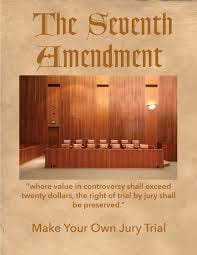
Every Friday until the end of 2025, we will publish a post about each of the 27 Amendments to the Constitution.
The 7th Amendment, ratified as part of the Bill of Rights in 1791, guarantees the right to a jury trial in civil cases where the value in controversy exceeds twenty dollars. Based on the common law tradition, it is designed to balance the power of the judiciary and safeguard against potential governmental overreach, and ensure that citizens, not just judges, have a say in the adjudication of civil disputes, thereby fostering a more democratic legal process.
The common law tradition originated in England and relies on case law and judicial decisions to develop and interpret legal principles. Unlike legal systems that are based primarily on written statutes or codes, Judges in common law systems play a significant role in shaping the law by interpreting past decisions and applying them to new situations. This tradition aims to ensure consistency and fairness in legal proceedings by following established precedents, while also allowing for flexibility and adaptation over time. The common law tradition influences the interpretation of amendments like the 7th Amendment, which emphasizes the importance of a jury trial in civil cases.
Essentially, the 7th Amendment represents the idea that average citizens should participate directly in the judicial process. A jury of peers brings diverse perspectives, fostering empathy and fairness that a single judge might overlook. Moreover, jury deliberations contribute to the development of common law by setting precedents grounded in societal values.
Recently, the right to a jury trial in civil cases has faced numerous challenges. The complexity and cost of litigation can deter individuals from pursuing jury trials. Also, the prevalence of arbitration clauses in contracts often circumvents jury trials altogether, funneling disputes into private arbitration settings.
The 7th Amendment is designed to focus on fairness and public involvement in the civil legal system for everyone, and it gives litigants a choice for their civil trial between a judge and a jury.
If you like us, REALLY like us, please click the little heart “Like” button at the top of this post!

Buttons:
Heart: Like Bubble: Comment Arrow Up: Share Arrows Circle: Restack
If you like us, REALLY like us, please click the “Like” button at the top of this post!
Your “Likes” mean a LOT to us! We appreciate your support!
Buy Pam a cup of Colombian Coffee!
Engage with us and our posts on Substack Notes, where we publish new content almost daily.
Our July 2025 subscriber goals are 400 new free subscribers and 80 new paid subscribers! You can help us reach our goal!
We Are Speaking is a reader-supported publication. To receive new posts and support our work, consider becoming a free or paid subscriber.
Follow Pam on Bluesky, the best “X” alternative.
Follow Keith on Bluesky, the best “X alternative.
Independent Authors and Creative Professionals: Check out my valuable books and courses on Branding and Marketing just for you via Pam Speaks 2 You.


Thomas Jefferson said, "The jury system is the foremost guarantee of democracy." He's right.
Believe it or not, I actually enjoy getting to do my duty as a citizen. It's important.
I also have this joke...me on the witness stand.
"Do you swear to tell the truth, the whole truth, and nothing but the truth?"
"I do...you're ugly. And Juror Number Six, I want to have dinner with you."
Thanks for this.