Our goal is to make “We Are Speaking” a best-selling publication by July 1, 2026, increasing our reach and influence! To achieve our goal, we will need 15 new paid subscribers every week, or 5 paid subscribers per day for the three days a week we publish. If you value our publication, please consider becoming a paid subscriber for $5/month or $50/year. We appreciate your financial support!
From the earliest days of this country, white Christian males were always prioritized for voting rights. At first, the government limited voting to white men who owned property. It took a few decades for voting to be allowed for all white men in the early 19th century. Women (white women, that is), of course, did not achieve full suffrage until 1920.
Roger B. Taney, the fifth Chief Justice of the United States Supreme Court, was the brother-in-law of Francis Scott Key (1779–1843), who wrote the lyrics to the national anthem, “The Star-Spangled Banner”. Taney led a 7-2 SCOTUS decision in the 1857 Dred Scott V Sandford case that declared enslaved people were not citizens of the United States and, therefore, could not expect any protection from the federal government or the courts. The opinion also stated that Congress had no authority to ban slavery from a Federal territory. This decision is thought to be one of the reasons for the Civil War.
After the Civil War, there were three “Reconstruction Amendments” that purported to grant citizenship rights to the previously enslaved men as well as to everyone born on U.S. soil.
Specifically, the Fifteenth Amendment, ratified on February 3, 1870, prohibited the U.S. government and states from denying a citizen the right to vote based on “race, color, or previous condition of servitude”. As the third “Reconstruction Amendment,” it was intended to guarantee suffrage for Black men, though its enforcement was undermined for decades by state-level restrictions such as poll taxes and literacy tests.
Again, women, indigenous men, and Asians, particularly the Chinese, were not included in this amendment, as they were not considered to be full American citizens.
In 1896, the Plessy v. Ferguson SCOTUS decision ruled that racial segregation laws did not violate the U.S. Constitution as long as the facilities for each race were equal in quality, a doctrine that came to be known as “separate but equal.” The final separate but equal laws were not struck down until the 1950s.
Meanwhile, from the late 19th century on, many Southern states passed laws that restricted voting by Black men, including a “grandfather clause” that stated that a man could vote if his grandfather was able to vote. Of course, the grandfathers of the previously enslaved could not vote. There were also literacy tests, poll taxes, and tricks like requiring a person to correctly count the number of jelly beans in a jar.
Also in 1870, the Department of Justice (DOJ) was formed, specifically to counter the attacks on Black people by the Ku Klux Klan. While our government has had an attorney general since the beginning, the Department of Justice started almost one hundred years later. Now, the DOJ under Donald Trump is working hard to restrict the rights of individuals and organizations that Trump doesn’t like.
For almost a century, many Black people and a lot of white allies were attacked, beaten, lynched, or otherwise killed just for trying to register to vote. By 1940, only 3% of Black people in the South were registered to vote.
In 1954, the U.S. Supreme Court decided the landmark case Brown v. Board of Education of Topeka. The unanimous ruling declared that racial segregation in public schools violates the 14th Amendment’s Equal Protection Clause, effectively overturning the “separate but equal” doctrine.
On December 1, 1955, the Montgomery (AL) bus boycott began after Rosa Parks, a secretary for the Montgomery NAACP chapter, deliberately refused to give up her seat for a white rider. This action marked the beginning of the modern civil rights movement.
In 1964, President Lyndon B. Johnson signed the 1964 Civil Rights Act into law.
In March of 1965, hundreds of people participated in the Selma to Montgomery March across the Edmund Pettus Bridge. (The Edmund Pettus Bridge was named after Edmund Winston Pettus, a Confederate brigadier general, U.S. Senator, and a leading member of the Ku Klux Klan in Alabama. Dedicated in 1940, the bridge was named to honor his legacy as a white supremacist leader who worked to maintain white power and restrict African-American rights.)
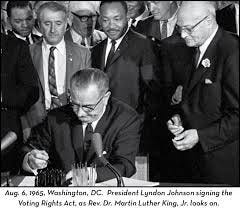
In 1965, President Johnson signed the Voting Rights Act (VRA) into law.
The number of Black politicians winning posts exploded
Since then, the VRA has been re-approved and re-authorized by a bipartisan Congress and by Republican presidents every few years.
Until 2010. That year is when a series of voting restriction laws and policies started being passed by mostly by southern states, attempting to once again limit the voting rights of Black people and other non-whites.
On June 25, 2013, in Shelby v. Holder, the Court ruled by a 5-4 vote that Section 4(b) was unconstitutional because the coverage formula was based on data more than 40 years old. This ruling also made Section 5 of the VRA almost moot. Eric Holder was the Attorney General of the United States at that time.
Claims have been made that the ruling has made it easier for state officials to engage in voter suppression. Research shows that preclearance led to increases in minority congressional representation and minority voter turnout. Five years after the ruling, nearly 1,000 U.S. polling places had closed, many of them in predominantly African-American counties. There were also cuts to early voting, purges of voter rolls, and imposition of strict voter ID laws. Today, the Republicans are still trying to implement these restrictions.
In the summer of 2016, during the presidential campaign season, Barack Obama and Hillary Clinton warned us about the Supreme Court and the damage that electing Donald Trump would do if he had the chance to nominate SCOTUS justices, and that is exactly what has happened.
On April 29, 2026, the Supreme Court ruled 6-3 in Louisiana v. Callais that a Louisiana congressional map featuring two majority-Black districts was an unconstitutional racial gerrymander, limiting the scope of the Voting Rights Act. The conservative majority held that race cannot be the primary factor in redistricting, potentially overturning efforts to create additional minority-represented districts.
One hundred and fifty-six years after the 15th Amendment was ratified, this decision nullifies Section 2 of the 1965 Voting Rights Act.
So now what do we do? Former President Barack Obama and many others have said that we cannot waste time feeling despondent.
With all of the mid-decade gerrymandering efforts and other voter intimidation and restriction actions being attempted, we must work even harder to ensure that the 2026 midterms and 2028 presidential election are free and fair.
It is already May, and the summer primaries are coming up soon. We must vote in the primaries and in the November general elections like we’ve never voted before.
And then, we must work to ensure that the results in November are not ruled invalid by the Republicans, and that the new Congress is seated without incident on January 3, 2027.
With Democratic majorities in both the House and the Senate in 2027, we can pass the John Lewis Voting Rights Advancement Act, which is aimed at restoring and strengthening the Voting Rights Act of 1965 and reinstating a “preclearance” mechanism for states with recent voting rights violations, requiring them to get federal approval from the DOJ or a DC federal court before changing voting laws.
Donald Trump would most likely veto the bill, so Congress would have to override the veto.
What can and will you do to help ensure that our voting rights are protected?
Our goal is to make “We Are Speaking” a best-selling publication by July 1, 2026, increasing our reach and influence! To achieve our goal, we will need 15 new paid subscribers every week, or 5 paid subscribers per day for the three days a week we publish. If you value our publication, please consider becoming a paid subscriber for $5/month or $50/year. We appreciate your financial support!