

Issue #86 American History Jury 18, 2022
Paid subscribers can listen to a narration of this entire article by clicking on the recording in the middle of the post or clicking on the headphones icon.
In the original Constitution that was ratified in 1788 and took effect in 1789, women of any race were not considered citizens of the United States. Women were essentially considered “property” of their husbands and had almost no rights of their own, including the right to vote.
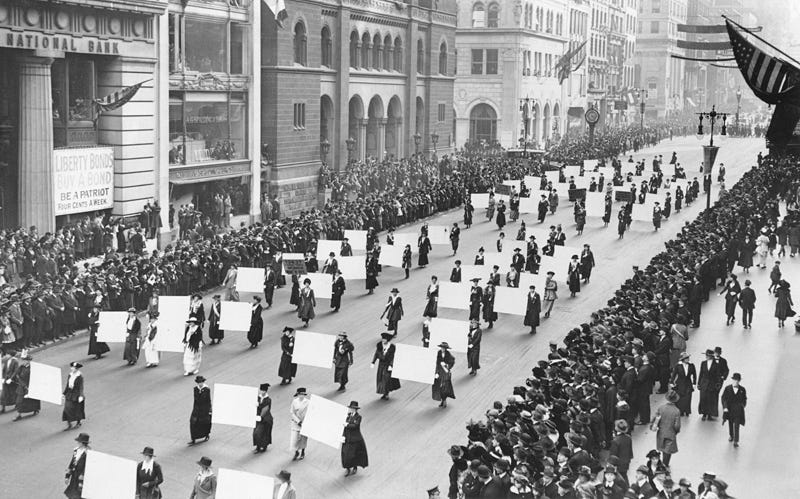
It took 131 years for women to officially receive the right to vote from the federal government, but the fight was not linear. In the 19th century, the efforts for women’s suffrage were often linked with abolitionist movements.
Women were finally awarded full citizenship in 1920 with the ratification of the 19th Amendment, but just as happened when Black men supposedly gained full citizenship with the 15th Amendment that was ratified in 1870, full enfranchisement for women in 1920 was neither “full” nor racially “equal.”
Just as we are seeing with the destruction of federal rights of full bodily agency for women with the recent Supreme Court decision to strike down Roe v Wade, the entire point since the beginning of this country has been about control by one subset of the population over women and other demographic groups.
The Timeline for Women’s Suffrage
