

Issue #1,033 Today In Black History, Monday, June 1, 2026
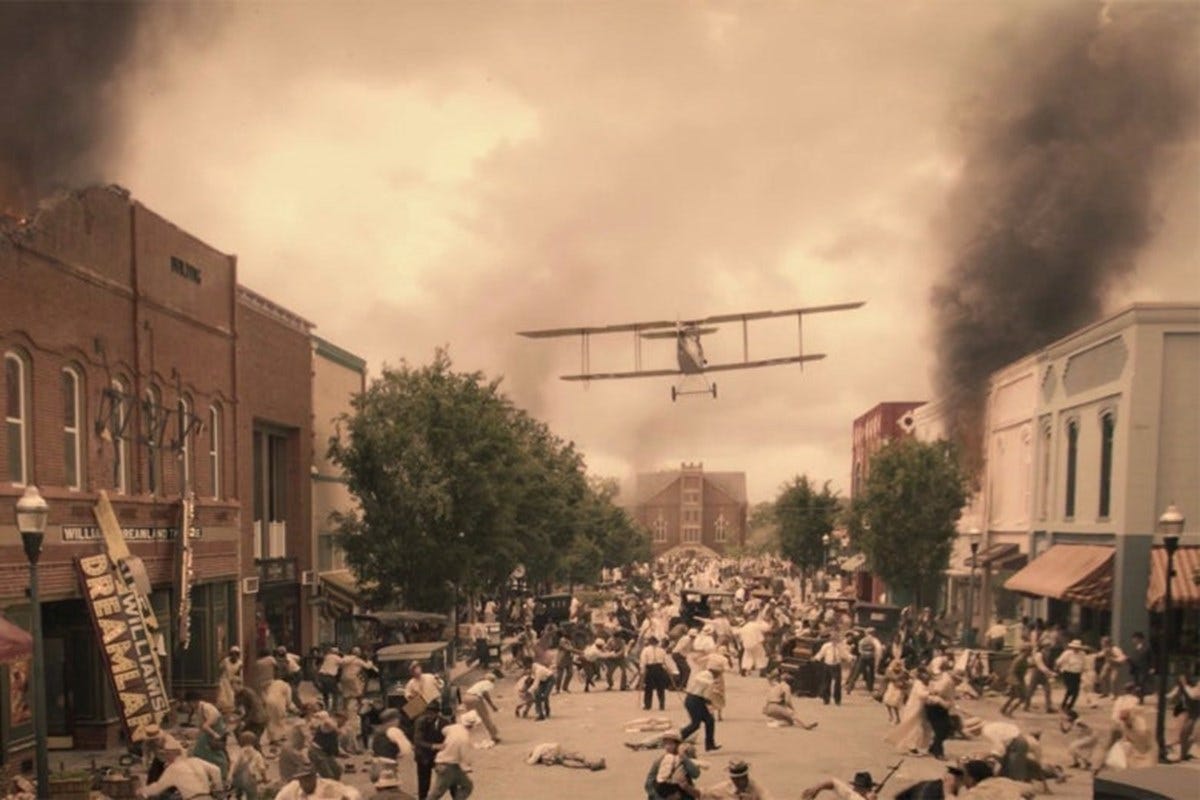
The Tulsa Massacre
The Origins of Greenwood
During the official “Indian Removal” that took place in much of the 19th century, free Blacks and the slaves and relatives of the “Five Civilized Tribes” (the Cherokee, Muskogee, Seminole, Chickasaw, and Choctaw nations) ended up settling (voluntarily or involuntarily) in the Oklahoma Territory, which was also set up as “Indian Territory” until Oklahoma became a state in 1907. The then-majority-Black population hoped to escape the slavery and Jim Crow laws of their previous residences.
In the early 20th century, hundreds of Black people established their own highly successful businesses, churches, schools, and other institutions in a 4,000-acre area on the edge of the Tulsa community. As recommended by Booker T. Washington and supervised by C.W. Greene, the area was called “Greenwood” and formally organized in 1901. By 1921, there were about 10,000 Black residents of Greenwood.
Black Wall Street
The Greenwood district was one of the most commercially successful and affluent majority African-American communities in the United States. In addition to the businesses, schools, and churches, Greenwood also had African-American attorneys, entrepreneurs, doctors, and other professionals. It was known across America as “Black Wall Street.”
As the population grew and the land expansion started touching on the boundaries of the segregated white areas of Tulsa, white residents became increasingly resentful and jealous of the wealth of the Greenwood community.
One day, a Black shoe shiner was falsely accused of assaulting a white woman on an elevator, and the Tulsa Race Massacre started.
For decades, “mainstream historians” called this event the “Tulsa Race Riot,” implying that the Blacks were the perpetrators and the source of the problem. It is only relatively recently that this is now called the…
Tulsa Race MASSACRE
There are many conflicting reports about the initial incident that sparked the white mob attacks, but most people agree that a 19-year-old Black shoe shiner who worked in a building in Tulsa near Greenwood was getting on the elevator run by a 17-year-old white girl to get to the top floor where the colored bathroom was located, and apparently touched her in some way.
The Black young man was arrested, and there were rumors that he might be lynched. That brought many Blacks to the courthouse to attempt to defend him, and several altercations between armed Blacks and whites ensued.
The smaller incidents escalated on Memorial Day, Tuesday, May 31, and by Wednesday, June 1, the white mobs, armed with rifles and machine guns, were looting homes and businesses in Greenwood and taking Black residents to detention or shooting them in the streets. The Tulsa police chief deputized many white men and authorized them to go into Greenwood to stop the “Negro uprising.”
Early in the morning of June 1, according to several eyewitness reports, at least 12 private planes began circling Greenwood and dropping burning turpentine balls onto multiple buildings in the neighborhood. This was the first time that an American city was attacked with bombs from airplanes.
Finally, later on Wednesday, June 1, the Oklahoma National Guard was deployed, martial law was declared, and the massacre and related activities ended.
Although exact numbers are not available, it is estimated that between 100 and 300 people died, and the entire commercial area of Greenwood, including 191 businesses, a junior high school, several churches, and the only Black hospital, was destroyed. About 1,500 homes were burned or looted. The estimated property damage totaled more than $33 million (in 2020 dollars).
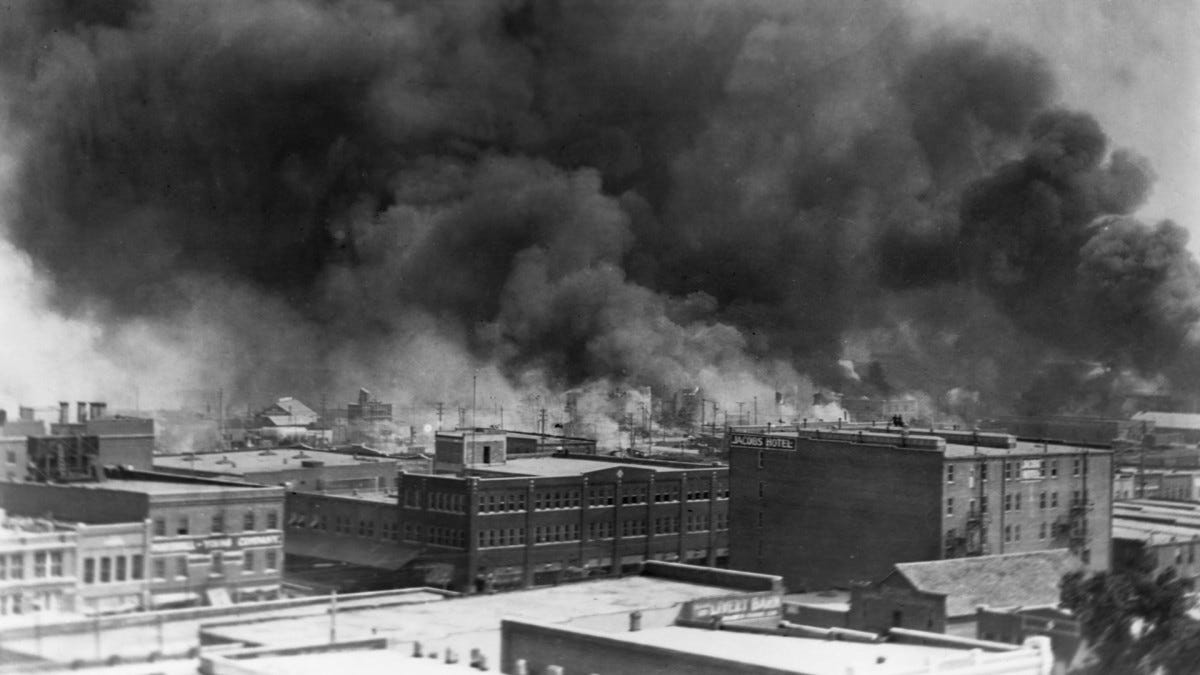
Photo Credit: Getty Images
Tulsa was not the first nor the last…
Although the Tulsa Massacre was the first time an American city was bombed from the air with official government approval, the event was not the first nor the last of similar incidents where white mobs destroyed Black areas in the United States.
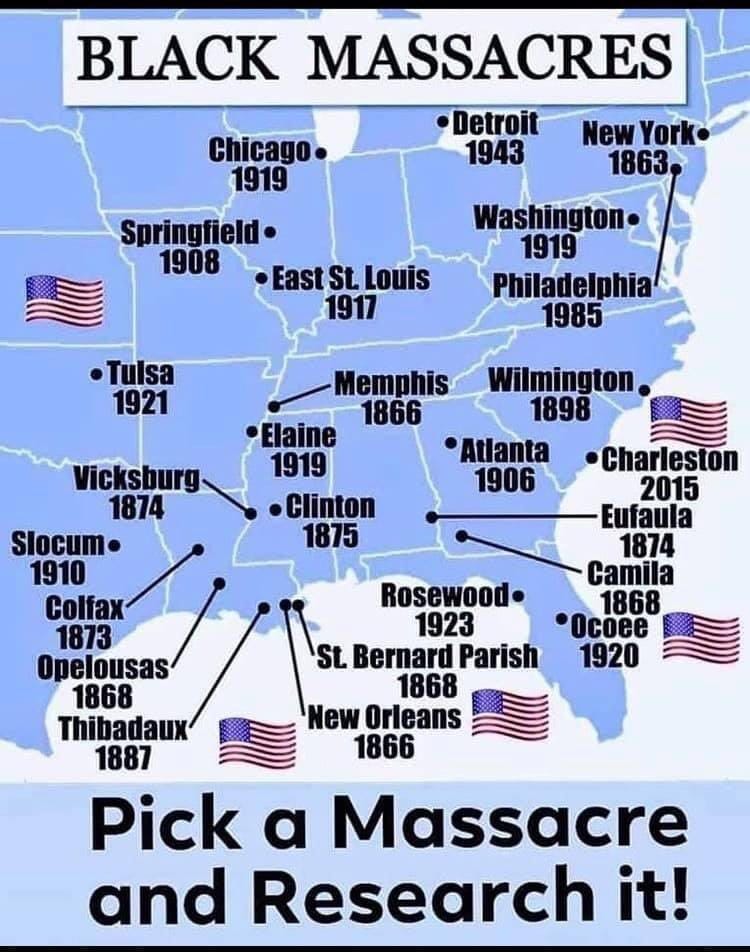
The activist and entertainer Common devised a map of many of the areas of devastation over the last 150 years or so. Common urges people to do their own research into these events so that we never forget and never let such massacres happen again in America.
Today In Black History
In 1835, the 6th National Black Convention met in Philadelphia with 35 delegates from six states and the District of Columbia.
In 1843, Sojourner Truth (Isabella Baumfree), a preacher, abolitionist, public speaker, and women’s rights advocate, left New York and began her 1st journey to help escaped Blacks find housing and work in the North.
In 1855, U.S. adventurer William Walker conquered Nicaragua and reestablished slavery in that country.
In 1862, the African Slave Trade Treaty ADT was passed as a bilateral treaty between the U.S. and the UK, abolishing the slave trade in all U.S. possessions.
In 1864, the Florida General Assembly, composed of 19 Black and 57 white members, met in Tallahassee.
In 1868, the Texas constitutional convention, composed of 9 Black and 81 white delegates, met in Austin.
In 1941, the 85th Tank Battalion, the first Black tank battalion, was activated.
In 1963, Jomo Kenyatta was sworn in as the first prime minister of the Dominion of Kenya.
In 1973, WGPR of Detroit, Michigan, became the 1st Black-owned television station permitted to operate.
In 1977, the American Heritage magazine published the oldest identifiable photographs of African slaves.
In 1995, Andrew F. Brimmer became the first Black governor of the Federal Reserve.
In 1995, Esther Silver-Parker became the first Black president of the AT&T Foundation.
Please share and subscribe to help us grow this publication.
If you like us, REALLY like us, please click the “Like” button at the end of this post!
We appreciate your support!
You are welcome to view “We Are Speaking” in Substack Notes. You can also read other Substack publications without subscribing to them when you join Notes.
To financially support “We Are Speaking” for no more than $5 per month, please subscribe at the paid level.
