Issue #1,029 Today In Black History, Wednesday, May 20, 2026
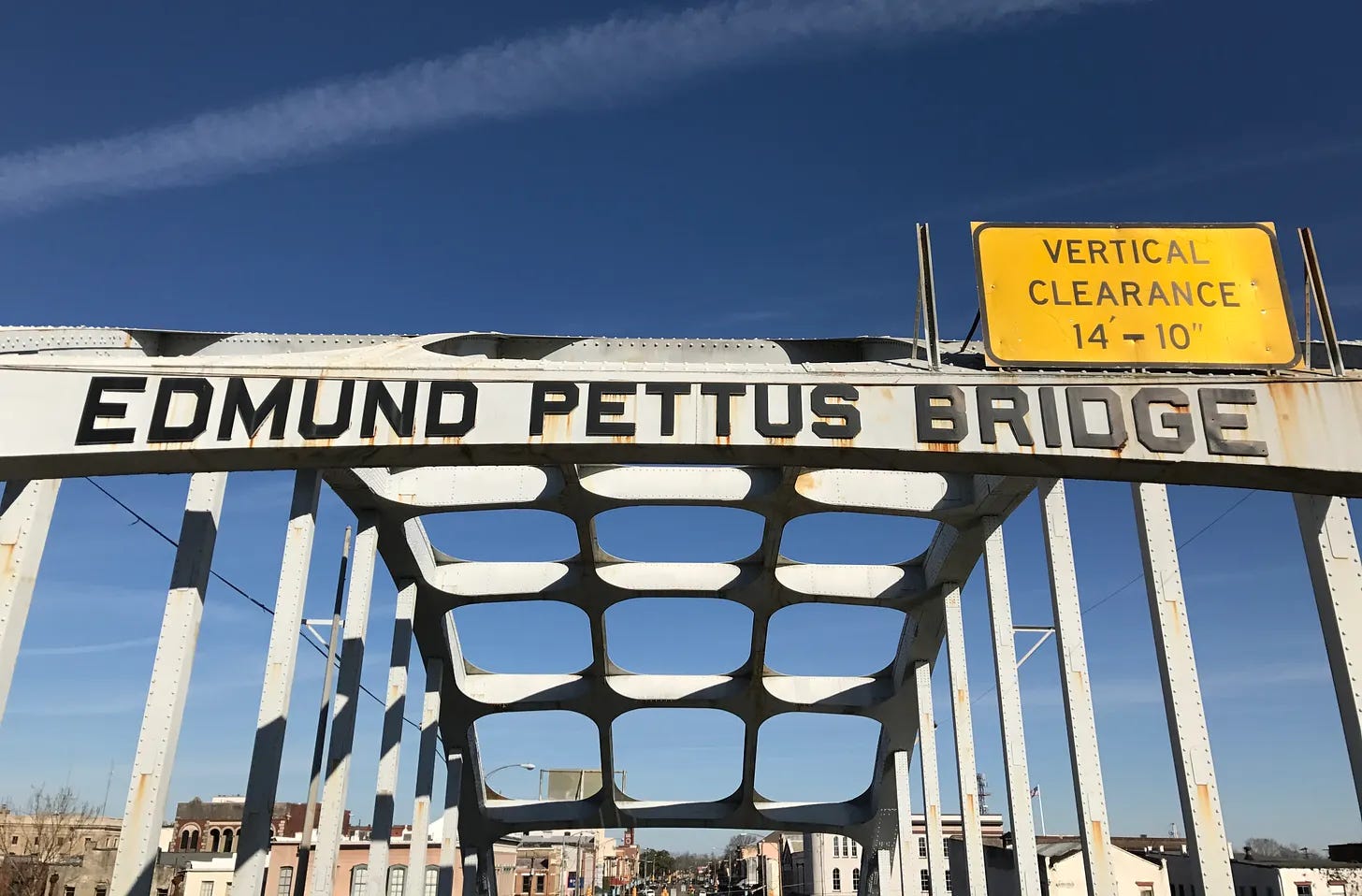
Photo by Jonathan Capehart
THANK YOU to all of our wonderful subscribers!
Our goal is to make “We Are Speaking” a best-selling publication by December 31, 2026, increasing our reach and influence! To achieve our goal, we will need 15 new paid subscribers every week, or 5 new paid subscribers for each of the three days per week we publish. If you value our publication, please consider becoming a paid subscriber for just $5/month or $50/year. We appreciate your financial support! We appreciate your financial support!
All new subscribers (free and paid) will receive this valuable eBook! If you don’t have yours, download it below.
Reclaiming The Narrative Why Learning Black History Changes Everything Generic Copy
On Sunday, May 17, 2026, hundreds of voting rights supporters once again marched across the Edmund Pettus Bridge in Selma, Alabama. This march was in response to the April 29, 2026, SCOTUS decision in Louisiana v. Callais, whichconcluded that using race as the primary factor in creating a second majority-minority district violates the 14th Amendment.
Edmund Winston Pettus (July 6, 1821 – July 27, 1907) was an American lawyer, politician, and military officer who represented Alabama in the United States Senate from 1897 to 1907. He first served as a senior officer of the Confederate States Army. After the war, he was Grand Dragon of the Ku Klux Klan, which terrorized and often killed African Americans.
The Edmund Pettus Bridge was named after him to memorialize his history of restraining and imprisoning African Americans in their quest for freedom after the Civil War.
The Department of Justice was instituted in 1870 primarily to find and arrest Ku Klux Klan members who were killing African Americans trying to exercise their right to vote.
A History of Voter Suppression and Solutions Throughout American History
The right to vote stands as a cornerstone of democracy, yet throughout American history, millions have been systematically prevented from exercising this fundamental right. Voter suppression has taken many forms, evolving across two and one-half centuries to maintain white power structures and limit political participation among marginalized communities.
The Early Era of Voter Suppression
From the nation’s founding, voting rights were restricted to white male property owners. Women were entirely excluded until the 19th Amendment in 1920, while Black Americans faced centuries of disenfranchisement. After the Civil War, Reconstruction-era policies briefly expanded voting rights, but the subsequent rise of Jim Crow laws in the South reintroduced systematic barriers, including literacy tests, poll taxes, and grandfather clauses. These mechanisms, though facially neutral, were deliberately designed to prevent Black citizens from voting while exempting white voters.
Twentieth-Century Tactics
The 20th century witnessed both persistence and evolution in voter suppression tactics. Literacy tests remained widespread despite widespread voter fraud and inconsistent administration. Poll taxes—fees required to vote—were weaponized against poor and minority voters. Grandfather clauses allowed individuals whose grandfathers could vote to bypass literacy tests, conveniently exempting most whites while excluding nearly all Black voters. Additionally, violence and intimidation through organizations like the Ku Klux Klan created a climate of fear that kept many from polling places.
Solutions and Legislative Response
The Civil Rights Movement catalyzed crucial legislative protections. The Voting Rights Act of 1965 represented a watershed moment, prohibiting literacy tests and requiring federal approval for changes to voting laws in jurisdictions with histories of discrimination. This landmark legislation, combined with the 24th Amendment, which eliminated poll taxes, removed many formal barriers. The National Voter Registration Act of 1993 further expanded access by requiring voter registration opportunities at various public agencies.
Modern Voter Suppression and Contemporary Solutions
Despite legal protections, voter suppression persists in modern forms. Voter ID laws, purges of voter rolls, limited polling locations in minority neighborhoods, and reduced early voting periods create new barriers—often disproportionately affecting communities of color and elderly voters. The Supreme Court’s 2013 Shelby County decision weakened the Voting Rights Act, eliminating preclearance requirements that had prevented discriminatory voting changes.
The latest Supreme Court decision on the Louisiana voter suppression/redistricting case is Louisiana v. Callais, decided on April 29, 2026.
The Ruling (6-3 Vote):The Court struck down Louisiana’s congressional map that created a second majority-Black district, calling it an “unconstitutional racial gerrymander.”
This case represents a major shift in voting rights law, significantly weakening protections that have been in place for decades.
Almost immediately, several southern states, all former Confederate states, started reworking their districts to dilute or eliminate Black representation.
These two Supreme Court decisions have all but obliterated the 1965 Voting Rights Act, but people are fighting back hard.
Contemporary solutions include comprehensive voting reform proposals. Automatic voter registration would remove administrative obstacles, while expanding early and mail-in voting provides flexibility and accessibility. Protecting voting rights for formerly incarcerated individuals restores political voice to communities historically targeted by the criminal justice system. States and advocacy organizations have also worked to prevent arbitrary voter roll purges and ensure adequate polling locations in underserved areas. Federal voting rights legislation, including the John Lewis Voting Rights Act, aims to restore protections weakened by recent court decisions.
When the Democrats regain the majority in the House after the 2026 midterms, restoring voting rights will be high on their agenda.
Today In Black History
In 1861, North Carolina became the 11th and last state to secede from the Union.
In 1868, P.B.S. Pinchback and James J. Harris served as delegates to the Republican National Convention, becoming the first Black people to hold national political positions.
In 1890, John Stephens Durham was named U.S. Consul to the Dominican Republic.
In 1942, the U.S. Navy first permitted Black recruits to serve.
In 1958, Robert Nelson C. Nix was elected as the first Blacks Congressman from Philadelphia.
In 1961, a white mob attacked the Freedom Riders in Montgomery, Alabama, causing Attorney General Robert F. Kennedy, Sr. to send in the National Guard.
In 2000, Octavia E. Butler’s “Parable of the Talents” won the 1999 Nebula Award for Best Novel.
In 2008, Senator Barack Obama (D-IL) obtained the majority of pledged delegates in the Democratic Primary.
Our goal is to make “We Are Speaking” a best-selling publication by December 31, 2026, increasing our reach and influence! To achieve our goal, we will need 15 new paid subscribers every week, or 5 new paid subscribers for each of the three days per week we publish. If you value our publication, please consider becoming a paid subscriber for just $5/month or $50/year. We appreciate your financial support! We appreciate your financial support!
You are also welcome to view “We Are Speaking” in Substack Notes. You can also read other Substack publications without subscribing to them when you join Notes.