

Issue #975 Today In Black History, Monday, January 12, 2026
Just over five years ago, on January 6, 2021, a riotous mob was called to the District of Columbia by Donald J. Trump as a last resort to stop the Constitutionally-mandated electoral count of the 2020 election. Trump maintained, and still does maintain, that he actually won that election, even in the face of evidence and lost lawsuits that upheld the election of Joe Biden as the 46th president of the United States.
After a rally on the Ellipse, where Trump encouraged his supporters to “Stop the Steal” and “Hang (VP) Mike Pence,” thousands of people marched to the U.S. Capitol Building, stormed the walls, broke into the building, and caused the House and Senate members to run for their lives, interrupting the vote count.
Luckily, two women Senate aides had the presence of mind to grab the wooden case with the official electoral votes and bring it with them as they fled.
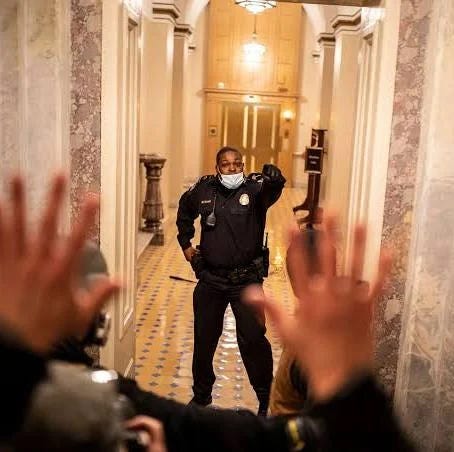
As chaos erupted at the United States Capitol, one man’s actions stood out as a symbol of courage and quick thinking: Capitol Police Officer Eugene Goodman. Amid the unprecedented attack, Goodman’s decisive response was crucial in protecting the nation’s lawmakers and upholding the democratic process.
As rioters breached the Capitol building, Officer Goodman found himself alone near the entrance to the Senate chamber. The mob, which was agitated and intent on disrupting the certification of the presidential election, surged through the halls. In those tense moments, Goodman recognized the immediate danger posed to the senators, many of whom were still inside the chamber or nearby.
Instead of confronting the crowd head-on, Goodman made a split-second decision that would prove pivotal. He positioned himself as a visible target, drawing the rioters’ attention. As they advanced, Goodman retreated up a staircase, deliberately leading them away from the unguarded Senate chamber doors. His actions were not random; he glanced toward the chamber, saw it was vulnerable, and then lured the mob in the opposite direction. This maneuver gave senators and staff precious time to evacuate or secure themselves, preventing what could have been a direct confrontation with the intruders.
Goodman’s calm under pressure and strategic thinking were captured on security footage, which later became a defining image of the day. The video shows him facing the crowd, using his voice and body language to control their movement, and ultimately guiding them toward a larger group of police officers who could better contain the situation.
In the aftermath, Goodman’s bravery was widely recognized. Lawmakers and citizens alike praised his actions, crediting him with averting a potential tragedy. His quick thinking not only protected lives but also preserved the Senate's integrity, allowing the certification process to resume later that evening.
For his heroism, Officer Eugene Goodman received numerous honors. He was chosen to escort Vice President Kamala Harris at the presidential inauguration, a symbolic gesture acknowledging his role in safeguarding democracy. Goodman was also promoted to acting deputy Senate Sergeant at Arms, reflecting the deep respect he earned from his colleagues and the nation.
In his first public interview after the attack, Goodman reflected on the gravity of the situation. He noted that the day “could’ve easily been a bloodbath,” emphasizing the importance of de-escalation and survival in such critical moments.
Officer Eugene Goodman’s actions on January 6 have become a lasting example of courage and service. In the face of danger, he relied on training, instinct, and a deep sense of responsibility to protect others. His story is a reminder that even in the darkest moments, individual acts of bravery can make a profound difference. His legacy continues to inspire, serving as a testament to the power of quick thinking, selflessness, and dedication to duty. On a day marked by turmoil deliberately instigated by the President of the United States, who was illegally attempting to hold onto power, his actions helped ensure that democracy prevailed.
Today In Black History
In 1863, President Jefferson Davis of the Confederate States of America delivered his “State of the Confederacy” address.
In 1948, the U.S. Supreme Court decided in Sipuel v Oklahoma State Board of Regents that a state must afford Blacks “an opportunity to commence the study of law at a state institution at the same time as other citizens.” Ada Lois Sipuel Fisher had previously been barred from the University of Oklahoma Law School.
In 1952, the University of Tennessee admitted its first Black student, Gene Mitchell Gray, as a graduate student in chemistry.
In 1957, the Southern Christian Leadership Council (SCLC) was founded at Ebenezer Missionary Baptist Church in Atlanta, with Rev. Dr. Martin Luther King, Jr., as its first president.
In 1959, Berry Gordy, Jr. launched Tamla Records (later renamed Motown) in Detroit, Michigan.
In 1967, the Louisville, Kentucky, draft board denied Muhammad Ali an exemption.
In 1971, the Congressional Black Caucus was organized.
In 1989, the African nation of Zaire expelled the ex-dictator of Uganda, Idi Amin.
In 2010, an earthquake devastated Haiti, killing an estimated 100,000 to 160,00 people and destroying the majority of the capital of Port-au-Prince.
In 2017, in a surprise presentation, President Barack Obama awarded the Presidential Medal of Freedom to Vice President Joe Biden.
Our “We Are Speaking” publication is not only a labor of love for us, but it also takes about 12 hours per week to research, write, edit, and publish.
Your financial contribution would be greatly appreciated as proof of your support for our valuable work.
WHAT A THRILLING STORY, and the picture says it all! WHAT A HERO! @marvelcomics here's your next star!