

Issue #960 Today In Black History, Monday, November 17, 2025
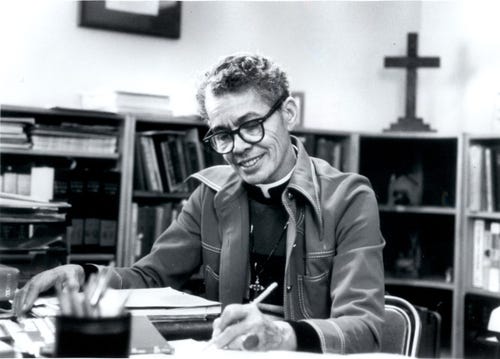
Born in 1910 in Baltimore, Maryland, and raised in Durham, North Carolina, Anna Pauline “Pauli” Murray emerged as a formidable figure in legal scholarship, activism, and spiritual leadership. Murray’s work influenced the civil rights movement and expanded legal protection for gender equality.
Murray was raised mostly by her maternal aunt in Durham, North Carolina. At age 16, she moved to New York City to attend Hunter College and graduated with a Bachelor of Arts degree in English in 1933. In 1940, Murray sat in the whites-only section of a Virginia bus with a friend, and they were arrested for violating state segregation laws. This incident and her subsequent involvement with the socialist Workers’ Defense League led her to pursue her career goal of becoming a civil rights lawyer. She enrolled in Howard University’s law school, where she was the only woman in her class.
Murray graduated first in the class of 1944, but she was denied the opportunity to pursue postgraduate work at Harvard University because of her gender. She called such prejudice against women “Jane Crow”, alluding to the Jim Crow laws that enforced racial segregation in the Southern United States.
She earned a master’s degree in law from the University of California, Berkeley, and in 1965 became the first African American to receive a Doctor of Juridical Science degree from Yale Law School.
After passing the California Bar Examination in 1945, Dr. Murray was hired as the state’s first Black deputy attorney general in January of the following year. That year, the National Council of Negro Women named her its “Woman of the Year,” and Mademoiselle magazine did the same in 1947. Dr. Murray was the first Black woman hired as an associate attorney at the Paul, Weiss law firm in New York City, where she worked from 1956 to 1960. She first met Ruth Bader Ginsburg at Paul, Weiss, when Ginsburg was briefly a summer associate there.
As one of the earliest proponents of an intersectional approach to justice, Pauli Murray co-authored a legal brief that laid the groundwork for the landmark Supreme Court decision in Brown v. Board of Education (1954), which declared racial segregation in public schools unconstitutional. Her forward-thinking scholarship was encapsulated in her famous 1950 publication, States’ Laws on Race and Color, which Thurgood Marshall himself described as the “Bible” for civil rights litigators.
Dr. Murray was appointed by President John F. Kennedy to serve on the 1961–1963 Presidential Commission on the Status of Women. In 1966, she was a co-founder of the National Organization for Women.
In addition to her influence in racial justice, Dr. Murray was a staunch advocate for gender equality. A co-founder of the National Organization for Women (NOW) in 1966, she tirelessly worked to dismantle gender-based discrimination. Her advocacy was instrumental in the inclusion of “sex” as a protected category under Title VII of the Civil Rights Act of 1964, helping to pave the way for future legal battles against gender discrimination.
Ruth Bader Ginsburg named Murray as a coauthor of the ACLU brief in the landmark 1971 Supreme Court case Reed v. Reed, in recognition of her pioneering work on gender discrimination. This case articulated the “failure of the courts to recognize sex discrimination for what it is and its common features with other types of arbitrary discrimination.”
Dr. Murray later held faculty or administrative positions at the Ghana School of Law, Benedict College, and Brandeis University.
Dr. Murray pursued a calling in religious ministry in her later years. In 1977, she became the first African American woman to be ordained as an Episcopal priest, challenging longstanding norms and inspiring a new generation of clergy.
In addition to her legal and advocacy work, Dr. Murray published two well-reviewed autobiographies and a volume of poetry. Initially published in 1970, the poetry collection Dark Testament was reissued in 2018.
Pauli Murray had a complex identity, but did not identify as a “lesbian,” instead seeing herself as a “man attracted to what she called ‘bisexual’ women”. Murray also expressed a male gender identity in her private writings and consistently used “she/her” in public during her lifetime.
On July 1, 1985, Rev. Dr. Pauli Murray died of pancreatic cancer in the house she owned with lifelong friend Maida Springer Kemp in Pittsburgh, Pennsylvania.
In 2012, the General Convention of the Episcopal Church voted to honor Rev. Dr. Murray as one of its Holy Women, Holy Men, to be commemorated on July 1, the anniversary of her death, along with fellow writer Harriet Beecher Stowe. Bishop Michael Curry of the Diocese of North Carolina said this recognition honors “people whose lives have exemplified what it means to follow in the footsteps of Jesus and make a difference in the world.”
Today In Black History
In 1842, the capture of escaped slave George Latimer in Boston led to the first of the fugitive slave cases. Boston abolitionists raised money to purchase Latimer from his slaveholder.
In 1903, the African nation of Dahomey (now known as Benin) became a French protectorate.
In 1911, Omega Psi Phi Fraternity was founded on the campus of Howard University by Edgar A. Love, Oscar J. Cooper, and Frank Coleman.
In 1972, 16 Black members were elected to Congress. Andrew Young of Atlanta was the first Black elected to Congress from the Deep South since Reconstruction. Also elected for the first time were Barbara Jordan (D-TX) and Yvonne Brathwaite Burke (D-CA). Republican Senator Edward W. Burke of Massachusetts was overwhelmingly elected for a second term.
