
Today In Black History: Claudette Colvin
A lesser-known but pivotal pioneer of the Civil Rights Movement

Issue #982 Today In Black History, Monday, January 26, 2026
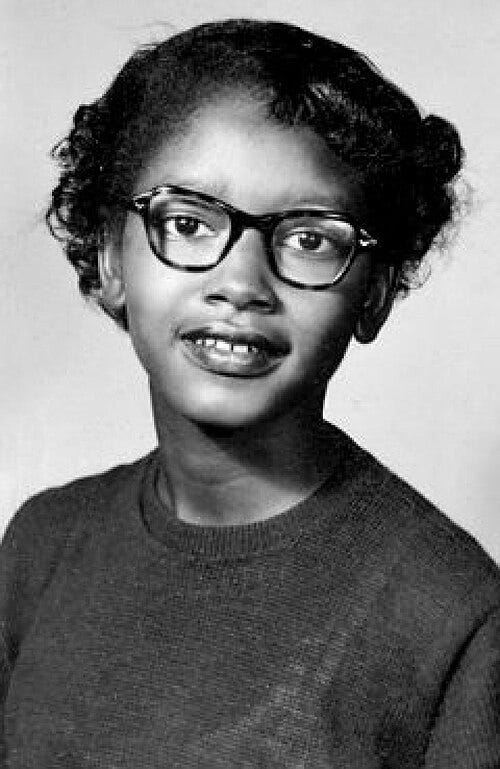
When discussing the Montgomery Bus Boycott, names like Rosa Parks and Rev. Dr. Martin Luther King Jr. often dominate the conversation. However, Claudette Colvin, a lesser-known yet equally significant figure, played a pivotal role in challenging racial segregation in America. Her courageous act of defiance at just 15 years old laid the groundwork for the Montgomery Bus Boycott.
Claudette Colvin was born on September 5, 1939, in Montgomery, Alabama, and was raised in a segregated community. Despite the challenges, Colvin excelled in school and was known for her intelligence and determination. She was particularly inspired by Black leaders and historical figures, which fueled her sense of justice and equality.
On March 2, 1955, nine months before Rosa Parks’ famous December 1, 1955, bus protest, Claudette Colvin refused to give up her seat to a white passenger on a segregated bus in Montgomery. At the time, it was customary—and legally enforced—for Black passengers to vacate their seats if the “white section” was full. Colvin, however, refused to move, citing her constitutional rights.
“I felt like Sojourner Truth was pushing down on one shoulder and Harriet Tubman was pushing down on the other,” Colvin later recalled. “I was glued to my seat.”
Her bold stand led to her arrest, and she was forcibly removed from the bus. This act of defiance was not just a personal decision but a reflection of her deep frustration with the systemic injustice she witnessed daily.
Colvin’s arrest did not immediately spark widespread action. At the time, civil rights leaders felt she was not the ideal face for the movement due to her age and personal circumstances. However, her case became a critical part of the legal battle against segregation.
In 1956, Colvin was one of four plaintiffs in Browder v. Gayle, the landmark case that ultimately led the Supreme Court to rule that bus segregation was unconstitutional. This decision was a monumental victory for the Civil Rights Movement and marked a turning point in the fight for racial equality.
Despite her significant contributions, Claudette Colvin’s story was largely overshadowed by Rosa Parks, whose protest later that year became the catalyst for the Montgomery Bus Boycott. Parks was older, married, already active with the local NAACP chapter, and seen as a more “respectable” figure by civil rights leaders, which made her a more suitable symbol for the movement at the time.
Colvin, on the other hand, faced stigma and isolation. She became pregnant shortly after her arrest, which further complicated her public image in the conservative society of the 1950s. As a result, her role in the movement was often downplayed or ignored.
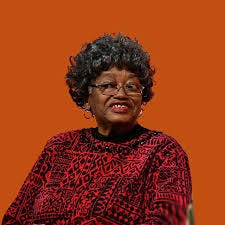
After the bus boycott and legal battles, Colvin moved to New York City, where she worked as a nurse’s aide for over three decades. She lived a relatively quiet life, raising her children and staying out of the public eye. It wasn’t until recent years that her contributions began to receive the recognition they deserve.
In 2021, Colvin’s juvenile record from her 1955 arrest was expunged, a symbolic gesture acknowledging the injustice she faced. Today, she is celebrated as a trailblazer whose bravery helped ignite the Civil Rights Movement.
Claudette Colvin’s courage as a teenager challenged the status quo and inspired others to fight for justice. While she may not have received the same level of recognition as some of her contemporaries, her influence is undeniable.
Colvin died under hospice care in Texas on January 13, 2026, at the age of 86.
Today In Black History
In 1863, the War Department authorized the governor of Massachusetts to recruit Black troops, and the 54th Massachusetts Volunteers was the first all-Black regiment recruited in the North.
In 1948, President Harry Truman signed Executive Order 9981 to end segregation in the U.S. Armed Forces.
In 1977, Andrew Jackson Young, Jr. was confirmed as UN Ambassador after being appointed by President Jimmy Carter as the first Black person in this position.
In 1997, Dr. Isaac B. Horton, III, the Black founder of Remote Source Lighting International, Inc. (RSLI), provided lighting for the NFL Super Bowl XXXI. RSLI has been recognized as the leading manufacturer of fiber optic lighting products, and Dr. Horton has applied for or been awarded over 70 patents.
In 1998, Dr. Lani Guinier became the first Black woman to be named a tenured faculty member at Harvard Law School.
In 2008, Senator Barack Obama (D-IL) won the South Carolina Democratic Primary.
Our “We Are Speaking” publication is not only a labor of love for us, but it also takes about 12 hours per week to research, write, edit, and publish.
Your financial contribution would be greatly appreciated as proof of your support for our valuable work.