

Issue #980 Today In Black History, Wednesday, January 21, 2026
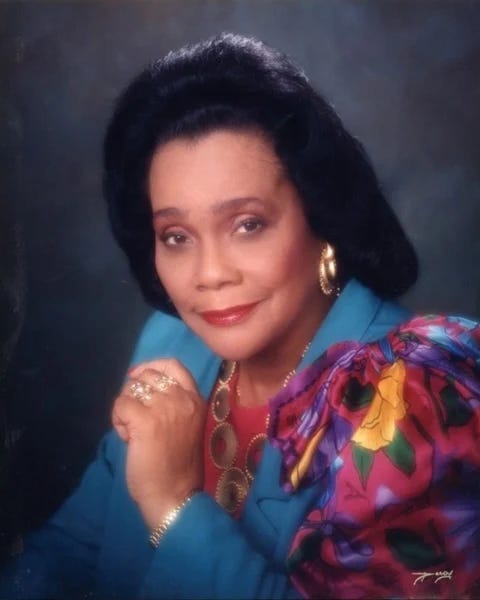
Coretta Scott King was a trailblazing civil rights leader, author, and activist whose legacy extends far beyond her role as the wife of Dr. Martin Luther King Jr. She was a powerful advocate for equality, justice, and peace, dedicating her life to advancing civil rights and human dignity. Her contributions to the movement and her work after her husband’s assassination position her as one of the most influential figures in American history.
Early Life and Education
Coretta Scott King was born on April 27, 1927, in Marion, Alabama, to Obadiah and Bernice Scott. The Scotts were a close-knit family that valued education and hard work. Her father was a successful entrepreneur who owned a sawmill, a farm, and a trucking business, which was rare for African Americans in the South during that time.
Coretta Scott attended Lincoln High School, where she graduated as valedictorian in 1945. Her academic achievements earned her a scholarship to Antioch College in Yellow Springs, Ohio, a progressive institution known for its commitment to social justice and equality. At Antioch, Coretta majored in music and education, laying the foundation for her lifelong passion for the arts and activism. Later, she faced racial discrimination when she was denied the opportunity to teach at a local school because of her race.
Musicianship and Artistic Talents
Coretta Scott King was a talented singer and pianist, and her musical abilities became a significant part of her identity.
After graduating from Antioch in 1951, Coretta earned a scholarship to the New England Conservatory of Music in Boston, where she pursued a degree in voice and violin. It was during her time in Boston that she met Martin Luther King Jr., a young theology student at Boston University. Their shared commitment to social justice and equality brought them together, and they married on June 18, 1953, in a ceremony officiated by Martin’s father, Rev. Martin Luther King, Sr.
Coretta’s musicianship played a unique role in her activism. She often used music as a tool for social change, performing freedom concerts that combined music, poetry, and speeches to raise awareness and funds for the civil rights movement.
Contributions to the Civil Rights Movement
As the wife of Martin Luther King Jr., Coretta Scott King was a steadfast partner in the civil rights movement. She balanced her roles as a mother, wife, and activist, often stepping into the spotlight to support her husband’s work. Coretta participated in marches, rallies, and protests, advocating for desegregation, voting rights, and economic justice.
One of her most notable contributions was her involvement in the Montgomery Bus Boycott of 1955-1956, a pivotal event in the civil rights movement. While Martin led the boycott, Coretta provided unwavering support, often facing threats and harassment from opponents of the movement. Despite the dangers, she remained resolute in her commitment to justice.
After Martin’s assassination in 1968, Coretta emerged as a leader in her own right. She founded the Martin Luther King Jr. Center for Nonviolent Social Change in Atlanta, Georgia, to preserve her husband’s legacy and continue his work. The King Center became a hub for education, advocacy, and activism, promoting nonviolence and social justice worldwide.
Advocacy Beyond the Civil Rights Movement
Coretta Scott King’s activism extended beyond the civil rights movement. She was a vocal advocate for women’s rights, LGBTQ+ rights, and global peace. She spoke out against apartheid in South Africa, supported labor unions, and worked to address poverty and economic inequality.
One of her most significant achievements was her role in establishing Martin Luther King Jr. Day as a federal holiday. Coretta tirelessly campaigned for the holiday, which was signed into law in 1983 by President Ronald Reagan and first observed in 1986.
Legacy and Impact
Coretta Scott King passed away on January 30, 2006, but her legacy continues to inspire people worldwide. She was a woman of remarkable strength, grace, and determination who dedicated her life to creating a more just and equitable society. Her work as an activist, artist, and leader has left an indelible mark on history.
Coretta Scott King’s contributions to the civil rights movement and her unwavering commitment to equality ensure that her story will remain a source of inspiration for generations to come.
Today In Black History
In 1773, poet Phillis Wheatley was born in Africa on May 8, 1753, captured at age 7, and brought to America as a slave on a ship named “The Phillis.” She was later freed, and her first book of poetry, Poems on Various Subjects, Religious and Moral, was published. The book of poetry was widely acclaimed in the United States and England.
In 1831, African Americans were forcibly removed from Portsmouth, Ohio.
In 1891, Black inventor P.D. Smith patented the potato digger, which increased potato yields.
In 1933, the all-Black American Bridge Association was founded.
In 1964, nationally renowned columnist Carl T. Rowan was named director of the United States Information Agency (USIA).
Our “We Are Speaking” publication is not only a labor of love for us, but it also takes about 12 hours per week to research, write, edit, and publish.
Your financial contribution would be greatly appreciated as proof of your support for our valuable work.