

Issue #1082: Today In Black History, Monday, October 5, 2026
As a small Substack publication, we could really use your support!
Please enter your email below to support us by subscribing at the free or paid level for less than $10/month.
Independent authors and creative professionals! Please scroll to the “Shameless Plug” at the end to find out about the Pam Speaks 2 You Creative Business Community app for creative branding and marketing.
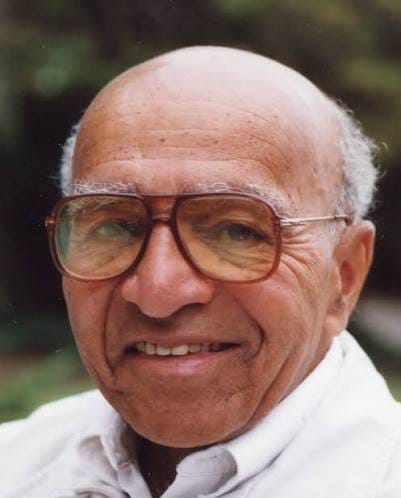
David Harold Blackwell spent his life on a question that sounds simple: how do we make good decisions when we can’t be sure what will happen? His answers helped shape modern statistics, game theory, and the mathematics behind today’s artificial intelligence. He did that work while facing doors that had been closed to him because he was Black.
Blackwell was born on April 24, 1919, in Centralia, Illinois. His father worked for the Illinois Central Railroad, and young David went to integrated schools, which was rare at the time. He didn’t care much for math until a high school geometry teacher showed him it could be about ideas rather than memorizing rules. He entered the University of Illinois at 16 and earned his bachelor’s degree, his master’s degree, and, in 1941, his Ph.D. at just 22. He was only the seventh African American to earn a doctorate in mathematics in the United States.
Doors That Would Not Open
After graduate school, Blackwell won a fellowship to the Institute for Advanced Study in Princeton, New Jersey. Fellows there were usually welcomed by nearby Princeton University, but the university objected to a Black scholar joining its ranks. In 1942, the statistician Jerzy Neyman tried to hire him at the University of California, Berkeley, and that effort was stopped by racial prejudice too. Blackwell later said he had sent letters to 105 historically Black colleges, assuming they were the only schools that would hire him.
He taught at Southern University and Clark College. In 1944, he joined Howard University, where he became chair of the mathematics department and stayed for ten years. During summers at the RAND Corporation, he began working in game theory, the study of strategy and competition. That became the start of his most important work.
A Career of Firsts
In 1955, Berkeley finally hired him, and Blackwell became the first Black tenured professor in the University of California’s history. Two years later, he chaired the statistics department. In 1965, he became the first African American elected to the National Academy of Sciences. He also served as president of the Institute of Mathematical Statistics and was the first Black member inducted into many of the field’s leading organizations.
His name is attached to some of statistics’ most widely used ideas. The Rao-Blackwell theorem shows how to turn a rough estimate into a better one. Blackwell’s work on comparing experiments helps researchers decide which kind of information is most useful. His approachability theorem explains how to reach a goal in a contest against an unpredictable opponent. His 1954 book with M. A. Girshick, Theory of Games and Statistical Decisions, became a standard text, and his 1969 textbook Basic Statistics was one of the first to teach beginners the Bayesian approach. Bayesian reasoning is now central to machine learning.
Blackwell said he wasn’t interested in doing research so much as in understanding things, and his students said that was how he taught. He was famous for making hard ideas clear. Over more than three decades at Berkeley, he supervised dozens of doctoral students, and he never stopped encouraging young Black mathematicians. He and his wife, Ann Madison, raised eight children.
Legacy
David Blackwell died on July 8, 2010, at age 91. In 2014, President Barack Obama awarded him the National Medal of Science posthumously. The Blackwell-Tapia Prize, named for him and mathematician Richard Tapia, honors scholars who expand opportunities for underrepresented groups in the mathematical sciences. In 2024, the chipmaker NVIDIA named its newest generation of AI processors “Blackwell” in his honor. That put his name, eighty years after he was shut out of Princeton and Berkeley, on the technology that powers the AI age.
Sources: INFORMS Biographical Profile; UC Berkeley Department of Statistics; Journal of Blacks in Higher Education; The Actuary Magazine; Wikipedia
Today In Black History
In 2022, Harvard University named Dr. Claudine Gay as its 30th and first Black President.
Paid subscribers can always leave questions in the comments or email us.
Please consider becoming a paid subscriber for $10/month or less to access all of the articles and other benefits.



If you are an independent author or creative professional, this is your chance to join the Pam Speaks 2 You Creative Business Community, and there’s an app for that! We have 5 eBooks and 5 courses, plus networking communities designed specifically for you!
The Pam Speaks 2 You Apple/iOS app is live!
The Pam Speaks 2 You Google/Android app is live!
You can also access the Pam Speaks 2 You app on the web!