

Issue #1066: Today In Black History, Monday, August 24, 2026
As a small Substack publication, we could really use your support!
Please scroll to the end of this post , or enter your email below to support us by subscribing at the free or paid level for less than $10/month.
Independent authors and creative professionals! Please scroll to the “Shameless Plug” at the end to find out about the Pam Speaks 2 You Creative Business Community app for creative branding and marketing.
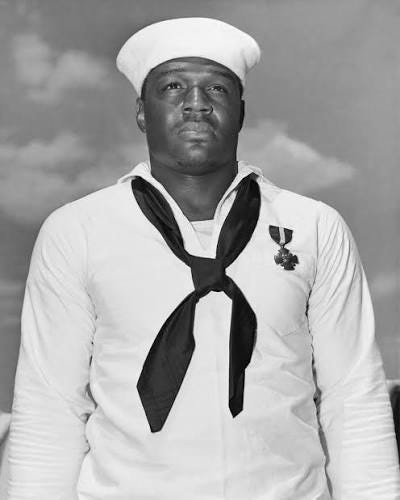
Doris “Dorie” Miller was born October 12, 1919, on a farm outside Waco, Texas, the third of four sons in a sharecropping family. He grew up working the land, playing fullback for Waco’s A.J. Moore High School, and helping support his household — experience that built the physical strength that would later serve him, and his country, in a moment no one could have prepared him for.
Miller enlisted in the U.S. Navy in 1939, partly to see the world and partly to earn money for his family. But the Navy of that era offered Black sailors almost no path beyond the galley. Under the segregation policies still enforced throughout the U.S. military, Black enlisted men were confined to the Messman Branch — cooking, serving, and cleaning for white officers — regardless of their skill, strength, or ambition. Miller became a mess attendant, and by 1941 he was a Ship’s Cook Third Class aboard the battleship USS West Virginia, barred by policy from formal weapons training even as tensions with Japan escalated.
That policy became irrelevant on the morning of December 7, 1941. When Japanese aircraft struck Pearl Harbor, Miller was collecting laundry aboard the West Virginia. As torpedoes and bombs tore into the ship, he rushed to his battle station, only to find it already destroyed. Instead, he moved through burning, oil-slicked wreckage to help carry wounded sailors to safety, including the ship’s mortally wounded commanding officer, Captain Mervyn Bennion. Then Miller did something he had never been trained to do: he took hold of an unmanned .50-caliber anti-aircraft machine gun and began firing at the attacking planes, continuing until he ran out of ammunition and was ordered to abandon ship. Accounts from fellow crew members credited him with downing several enemy aircraft, though the Navy’s official record left the exact number undetermined.
For his actions that day, Miller was awarded the Navy Cross, the Navy’s second-highest decoration for valor — the first ever given to a Black sailor. Fleet commander Admiral Chester Nimitz pinned the medal on Miller personally aboard the USS Enterprise on May 27, 1942, telling him, “This marks a new day for the Navy.” The citation praised his “distinguished devotion to duty, extraordinary courage and disregard for his own personal safety.” Miller also received the Purple Heart, the American Defense Service Medal, and other combat honors.
The Navy, still bound by segregation, sent Miller on a war bond and recruitment tour rather than offering him a combat command befitting his heroism. He was promoted to Mess Attendant First Class and later Ship’s Cook Third Class, but never granted the officer’s path his actions had earned in the public eye. In 1943, he was assigned to the escort carrier USS Liscome Bay. On November 24, 1943, off Butaritari Island near Tarawa, a Japanese submarine torpedo struck the ship’s bomb magazine, sinking it in minutes. Miller was among 646 crew members killed. He was 24 years old.
Doris Miller’s story became a turning point in the long fight to desegregate the U.S. armed forces, cited for years by advocates pressing for equal treatment of Black servicemen. The Navy has honored him repeatedly since: a frigate, USS Miller, was commissioned in his name in 1973, and in 2020 the Navy announced the aircraft carrier USS Doris Miller — the first carrier ever named for an enlisted sailor and the first named for a Black American. Congress has weighed posthumously awarding him the Medal of Honor, recognition many historians argue was denied him only because of his race.
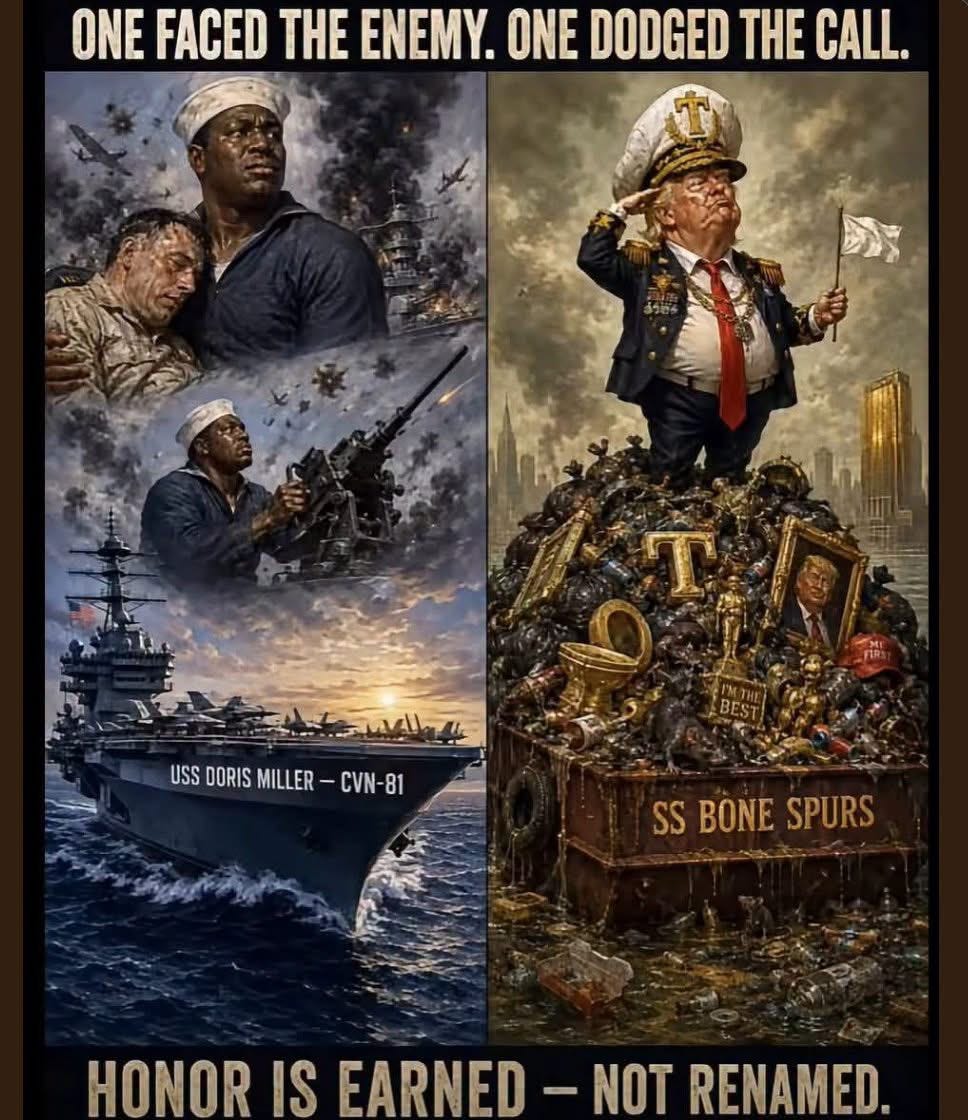
As we all know, Donald Trump fired all the qualified and experienced military leaders who were in charge when he became president the second time and replaced them with loyalists. The current Secretary of the Navy has proposed renaming the aircraft carrier USS Doris Miller, an actual war hero who died while serving, after Donald Trump, a 5-time draft dodger. This would be atrocious.
Sources:
Doris Miller | Biography, Facts, & Role at Pearl Harbor | Britannica
Cook Third Class Doris Miller | Naval History and Heritage Command
Doris Miller - Above and beyond the call of duty | VA History
Today In Black History
In 1839, Joseph Cinque and the slaves who seized the slave ship Aminstad and killed its captain and most of its crew were taken into custody as the ship anchored at Culloden Point of Long Island, NY.
In 1854, John V. DeGrasse, a prominent Black physician, was admitted to the Massachusetts Medical Society.
In 1950, Chicago attorney Edith Sampson was named the first Black representative (alternate delegate) in the U.S. delegation to the United Nations.
Paid subscribers can always leave questions in the comments or email us.
Please consider becoming a paid subscriber for $10/month or less to access all of the articles and other benefits.


If you are an independent author or creative professional, this is your chance to join the Pam Speaks 2 You Creative Business Community, and there’s an app for that!
The Pam Speaks 2 You Apple/iOS app is live!
The Pam Speaks 2 You Google/Android app is live!
You can also access the Pam Speaks 2 You app on the web!
Time to award him the Medal of Honor.