Issue #1,089 Today In Black History, Wednesday, October 21, 2026
Please enter your email below to support us by subscribing at the free or paid level for less than $10/month.
We Are Speaking is a small reader-supported publication. To receive new posts and support our work, consider subscribing at the free or paid level.
Independent authors and creative professionals! Please scroll to the “Shameless Plug” at the end to find out about the Pam Speaks 2 You Creative Business Community app for creative branding and marketing.
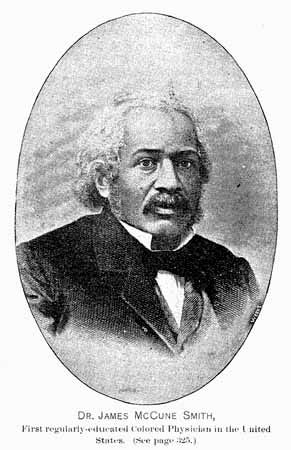
Long before Black doctors could train at American medical schools, one young man from Lower Manhattan crossed an ocean to earn the degree his own country refused him. Dr. James McCune Smith became the first African American to hold a medical degree. Then he came home and turned his scientific training into a weapon against slavery and the racist “science” used to defend it.
A Gifted Child of New York
James McCune Smith was born in New York City on April 18, 1813. His mother, Lavinia Smith, had been enslaved, and Smith himself was freed when New York’s gradual emancipation law took full effect in 1827. He studied at the African Free School, which educated many of the Black leaders of his generation. In 1824, when he was 11, the school chose him to give a welcoming speech to the Marquis de Lafayette, the French hero of the American Revolution, during his visit to New York.
Smith wanted to become a doctor, but medical colleges in the United States turned him away because he was Black. With help from abolitionist allies, he enrolled at the University of Glasgow in Scotland in 1832. There, he earned a bachelor’s degree, a master’s degree, and, in 1837, a doctor of medicine degree, finishing near the top of his class. While in Glasgow, he also joined the Glasgow Emancipation Society, beginning a lifelong commitment to the antislavery cause.
Healer, Pharmacist, and Scholar
Smith returned to New York in 1837 and opened a medical practice and pharmacy in Lower Manhattan, one of the country’s first Black-owned pharmacies. He treated Black and white patients alike. For nearly 20 years, he served as the doctor for the Colored Orphan Asylum, caring for hundreds of children. In 1863, during the New York City Draft Riots, a white mob burned the orphanage to the ground. The children got out alive, but the attack was a bitter reminder of the hatred Smith had spent his life opposing.
Smith was also the first African American to publish articles in American medical journals. Above all, he understood the power of data. When the 1840 U.S. Census claimed that free Black people suffered far higher rates of insanity than enslaved people, proslavery politicians such as John C. Calhoun used the figures to argue that freedom was harmful to Black Americans. Smith went through the numbers and showed they were riddled with errors. He also took apart phrenology and other pseudoscientific theories of racial inferiority, using evidence to answer prejudice.
A Voice for Freedom
Smith was a leading intellectual in the abolitionist movement. He worked closely with Frederick Douglass, helped found the National Council of Colored People in 1853, and wrote the introduction to Douglass’s 1855 autobiography, My Bondage and My Freedom. Under the pen name “Communipaw,” he wrote sharp, witty essays for Frederick Douglass’s paper. He fought for Black voting rights in New York, pushed for education and self-reliance in Black communities, and argued that Black Americans were full citizens of the nation they had helped build.
In 1863, Wilberforce University appointed him professor of anthropology, but heart disease kept him from taking the post. Dr. James McCune Smith died on November 17, 1865, just months after the Civil War ended and weeks before the Thirteenth Amendment abolished slavery.
His Lasting Influence
For many years after his death, Smith’s name faded from public memory. In 2010, his descendants placed a new headstone at his grave in Brooklyn’s Cypress Hills Cemetery. Today, historians recognize him as a pioneer. He opened the door for generations of Black physicians, and he set an example for public health researchers who use evidence to expose inequality.
The University of Glasgow now honors him with a building named for him.
Dr. James McCune Smith proved that carefully measured truth, boldly spoken, can stand up to power. His life reminds us that the fight for justice happens in the streets and the courts, and also in the clinic, the classroom, and the careful work of getting the facts right.
In 1835, the New York Antislavery Society was formed in Utica, New York, with about 600 delegates, despite a disruption by a pro-slavery mob.
In 1950, Earl Lloyd became the first Black person to play in an NBA game. He later became the NBA’s first Black Assistant Coach and first Black Chief Scout.
Paid subscribers can always leave questions in the comments or email us.
Please consider becoming a paid subscriber for $10/month or less to access all of the articles and other benefits.
If you are an independent author or creative professional, this is your chance to join the Pam Speaks 2 You Creative Business Community, and there’s an app for that! We have 5 eBooks and 5 courses, plus networking communities designed specifically for you in the Branding and Marketing Academy!