Issue #1,094 Today In Black History, Monday, November 2, 2026
Please enter your email below to support us by subscribing at the free or paid level for less than $10/month.
We Are Speaking is a small reader-supported publication. To receive new posts and support our work, consider subscribing at the free or paid level.
Independent authors and creative professionals! Please scroll to the “Shameless Plug” at the end to find out about the Pam Speaks 2 You Creative Business Community app for creative branding and marketing.
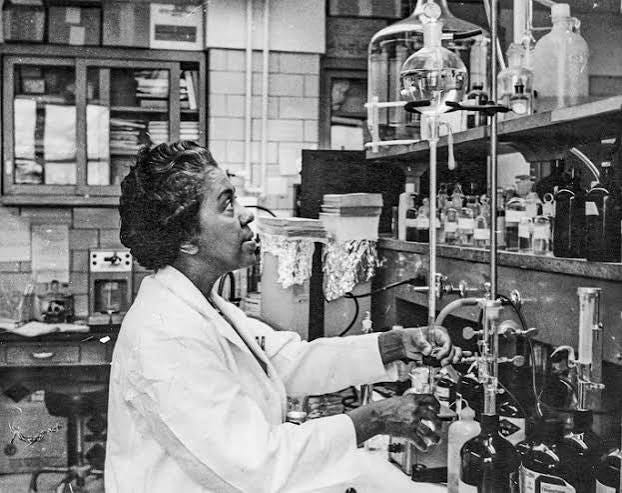
When Marie Maynard Daly received her doctorate from Columbia University in 1947, she quietly made history. She became the first Black woman in the United States to earn a Ph.D. in chemistry, a milestone reached in an era when universities, laboratories, and scientific societies routinely shut their doors to both women and African Americans. But the degree was only the beginning. Over a career spanning four decades, Dr. Daly helped uncover how the cell’s nucleus works, how diet affects the heart, and how high blood pressure damages the body.
A Father’s Dream, a Daughter’s Calling
Daly was born on April 16, 1921, in Corona, Queens, New York. Her father, Ivan C. Daly, had immigrated from the British West Indies and enrolled at Cornell University to study chemistry, but he could not afford to finish. Her family nurtured her love of reading, and as a girl she devoured books about scientists, including Paul de Kruif’s The Microbe Hunters. She attended Hunter College High School, a girls’ school where teachers encouraged her interest in chemistry.
She went on to Queens College, graduating magna cum laude in 1942 as a Queens College Scholar, an honor reserved for the top 2.5 percent of her class. She earned her master’s degree from New York University in just one year while working as a lab assistant, then entered Columbia’s doctoral program under biochemist Mary L. Caldwell. Her dissertation examined how a digestive enzyme breaks down corn starch.
Inside the Cell
After teaching at Howard University, Daly won an American Cancer Society grant in 1948 to join Alfred Mirsky’s laboratory at the Rockefeller Institute. For seven years she studied the cell nucleus and its proteins. Her work helped characterize histones, the proteins around which DNA is wound, and advanced the understanding of how cells build proteins. Her research came just as the double-helix structure of DNA was revealed in 1953, and histones are now known to play a key role in determining which genes are switched on or off.
Protecting the Heart
In 1955, Daly returned to Columbia’s College of Physicians and Surgeons, where she partnered with Dr. Quentin B. Deming. Together they produced some of the earliest research connecting diet to heart and circulatory health. Their studies showed that high cholesterol was linked to clogged arteries and that hypertension accelerated that damage. Daly also examined how sugar, aging, and cigarette smoke affected blood pressure and the lungs. Today’s familiar medical advice (watch your cholesterol, control your blood pressure, don’t smoke) rests in part on foundations she helped lay. In 1958, she became an investigator for the American Heart Association.
In 1960, she joined the Albert Einstein College of Medicine, where she taught biochemistry and medicine until her retirement in 1986.
Opening Doors for Others
Daly never forgot how few people who looked like her worked in America’s laboratories. Throughout her career, she pushed to increase the number of minority students in medical schools and graduate science programs. In 1988, she established a scholarship at Queens College in honor of her father to support Black students studying chemistry and physics, completing, in a sense, the education he never finished. She was named a fellow of the American Association for the Advancement of Science, and in 1999 the National Technical Association recognized her as one of the top 50 women in science, engineering, and technology.
Her Legacy
Dr. Daly died on October 28, 2003, at age 82. The Albert Einstein College of Medicine honors her with an annual memorial lecture, and a school in her home borough of Queens bears her name. Every time a doctor checks a patient’s cholesterol or blood pressure, her work is present in the room. Marie Maynard Daly proved that brilliance does not wait for permission, and she spent her life making sure the next generation would not have to wait either.
Please consider becoming a paid subscriber for $10/month or less to access all of the articles and other benefits.
If you are an independent author or creative professional, this is your chance to join the Pam Speaks 2 You Creative Business Community, and there’s an app for that! We have 5 eBooks and 5 courses, plus networking communities designed specifically for you in the Branding and Marketing Academy!




These are all wonderful. Thank you so much!