Issue #1,100 Today In Black History, Monday, November 16, 2026
Please enter your email below to support us by subscribing at the free or paid level for less than $10/month.
We Are Speaking is a small reader-supported publication. To receive new posts and support our work, consider subscribing at the free or paid level.
Independent authors and creative professionals! Please scroll to the “Shameless Plug” at the end to find out about the Pam Speaks 2 You Creative Business Community app for creative branding and marketing.
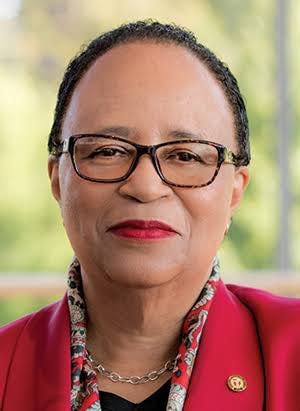
Dr. Shirley Ann Jackson: The Physicist Who Was the First Black Woman to Earn a PhD from MIT
Some people wait for the door to open. Dr. Shirley Ann Jackson built the door, walked through it, and then spent the rest of her career holding it open for everyone behind her.
Born August 5, 1946, in Washington, D.C., Jackson came of age in a city still shaped by segregation. Her curiosity showed up early. As a girl, she caught bees from the flowers and shrubs around her home and studied their daily rhythms, keeping careful notes like a scientist long before anyone called her one. Her parents fed that hunger. Her mother had finished college and done graduate work at a time when higher education did not welcome Black women. Her father never finished high school, but he had a gift for mechanics and math, and he passed it on.
That partnership mattered. A ripple tank is a shallow glass- or acrylic-bottomed tank filled with a small amount of water, used in physics to visually demonstrate and study wave behavior.
When a high school physics teacher refused to teach the class properly and told her that if she wanted a ripple tank she could build it herself, Jackson went home and did exactly that, with her father beside her. Before long, the teacher was letting Shirley teach the class. She graduated from Roosevelt High School in 1964 as valedictorian.
That fall she arrived at the Massachusetts Institute of Technology, one of only a handful of Black students on campus. She later described those years as isolating. Classmates avoided sitting next to her in lecture halls. She kept going anyway. She earned her bachelor’s degree in physics in 1968, then stayed for a Ph.D. in theoretical elementary particle physics, which she completed in 1973. With it, she became the first African American woman to earn a doctorate from MIT, and only the second African American woman in the United States to earn a doctorate in physics.
She did not keep that achievement to herself. While still a student, Jackson pushed MIT to recruit and support more Black students, served on the school’s Task Force on Educational Opportunity, and mentored younger students who went on to distinguished careers.
Her research took her to Bell Laboratories, where she studied the optical and electronic properties of extremely thin, layered materials, the kind of fundamental physics that underpins modern electronics. In 1991, she also joined the faculty at Rutgers University.
Then, in 1994, the White House called. President Bill Clinton asked her to lead the U.S. Nuclear Regulatory Commission. As chair from 1995 to 1999, Jackson brought a scientist’s rigor to how the nation measured risk at its nuclear power plants, and she helped found the International Nuclear Regulators Association, serving as its first chair.
In 1999, she became the 18th president of Rensselaer Polytechnic Institute, the country’s oldest technological research university. She was the first African American woman to lead a top-ranked research university. Over 23 years, she reshaped the campus, led fundraising that brought in more than a billion dollars, and expanded its research. She retired in 2022 as president emerita.
Washington kept calling on her, too. She served on President Obama’s Council of Advisors on Science and Technology and co-chaired the President’s Intelligence Advisory Board. In 2016, she received the National Medal of Science, the nation’s highest honor for achievement in science and engineering. She holds dozens of honorary doctorates.
Through it all, her message has stayed the same: talent comes in every color, gender, and background, and a nation that ignores that talent is wasting its future.
Dr. Shirley Ann Jackson was told, in ways large and small, that science was not for her. She answered by building the tank herself. Her life reminds every young Black girl staring at a closed door: you may have to build your own tools, but you belong in the room.
Today In Black History
In 1981, President Ronald Reagan fired Arthur S. Fleming, Chairman of the U.S. Commission on Civil Rights, allegedly for vocally supporting affirmative action.
In 1988, award-winning novelist Toni Morrison won the “Elmer Holmes Bobst Award in Arts and Letters for her book “Beloved,” which was later awarded the Pulitzer Prize for Fiction and the Anisfield-Wolf Book Award.
Paid subscribers can always leave questions in the comments or email us.
Please consider becoming a paid subscriber for $10/month or less to access all of the articles and other benefits.
If you are an independent author or creative professional, this is your chance to join the Pam Speaks 2 You Creative Business Community, and there’s an app for that! We have 5 eBooks and 5 courses, plus networking communities designed specifically for you in the Branding and Marketing Academy!