Issue #1,017 Today In Black History, Wednesday, April 15, 2026
Our goal is to make “We Are Speaking” a best-selling publication by July 1, 2026, increasing our reach and influence! To achieve our goal, we will need 15 new paid subscribers every week, or 5 new paid subscribers for each of the three days per week we publish. If you value our publication, please consider becoming a paid subscriber for just $5/month or $50/year. We appreciate your financial support! We appreciate your financial support!
Dr. Wendy Okolo: From Lagos to the Frontiers of Aerospace
With the successful Artemis II space mission, which included a diverse group of astronauts, it is a good time to learn about Black people, especially Black women, who have contributed to NASA’s successes.
Even though my parents were both scientists, I barely passed high school biology and abhorred cutting up frogs. In college, I was an English major. Science was never “my thing,” so I have enormous respect for people like today’s person in Black history.
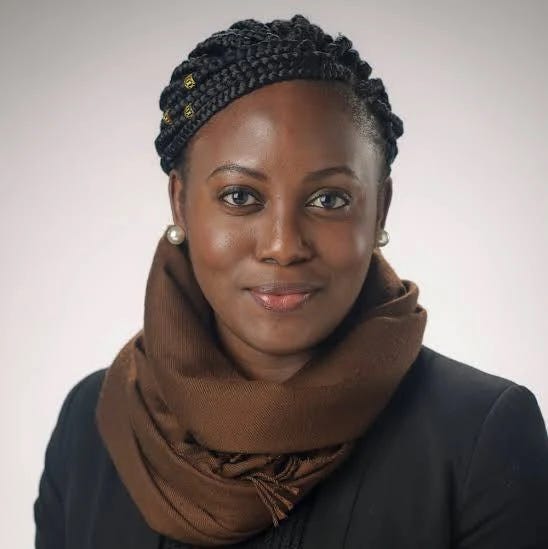
Dr. Wendy A. Okolo is a Nigerian-American aerospace research engineer in the Intelligent Systems Division at NASA Ames Research Center. She is the first Black woman to obtain a Ph.D. in aerospace engineering from the University of Texas at Arlington.
Born and raised in Lagos, she attended St. Mary’s Primary School and Queen’s College, one of Nigeria’s most respected all-girls secondary schools, before heading to the United States to pursue aerospace engineering. It was a bold leap — from Lagos to one of the most demanding fields in STEM. She credits her sisters, who taught her the sciences through their day-to-day realities, as her heroes.
She received a bachelor’s degree in aerospace engineering from the University of Texas at Arlington (UTA) in 2010, where she served as president of the Society of Women Engineers. As an undergraduate, she interned at Lockheed Martin on the Orion spacecraft, NASA’s crew exploration vehicle designed to facilitate human exploration beyond low Earth orbit.
At just 26, she became the first Black woman to earn a Ph.D. in aerospace engineering from the University of Texas at Arlington in 2015. Her graduate studies were recognized and funded by the U.S. Department of Defense through the National Defense Science and Engineering Graduate Fellowship, Zonta International through the Amelia Earhart Fellowship, the American Institute for Aeronautics and Astronautics, and the Texas Space Grant Consortium.
Dr. Okolo’s technical contributions span some of the most consequential areas in modern aerospace. Her expertise is in flight dynamics, vehicle controls, and systems health monitoring, exemplified by her work with the U.S. Air Force Research Laboratory on aircraft formation flight and the Advanced Development Programs of Lockheed Martin (Skunkworks) on performance-optimizing control for the F-35C aircraft.
At NASA, her research has pushed boundaries in flight safety and autonomous systems. She was the controls lead on a NASA early-career team that won $2.5 million to develop innovative techniques to guide and control an unconventional spacecraft, and she holds a U.S. patent for aerospace vehicle flight-path control. Her research includes developing advanced systems that enable aircraft and drones to detect faults early, making aviation smarter, safer, and more reliable.
At NASA, Dr. Okolo has been honored with the NASA Exceptional Technology Achievement Medal, the NASA Ames Award for Researcher/Scientist, and the NASA Ames Early Career Researcher Award — becoming the first woman ever to receive that last honor. Beyond NASA, she is also a recipient of the Women in Aerospace Award for Initiative, Inspiration & Impact, and the Black Engineer of the Year Award for Most Promising Engineer in U.S. Government.
Dr. Okolo’s impact reaches far beyond engineering equations and flight simulations. She served as the NASA Ames Special Emphasis Programs Manager for women, ensuring the recruitment, retention, and promotion of women. Her initiatives include creating nursing rooms for mothers to ease their transition back to work and analyzing job language in position descriptions to remove gender-biased language.
She is also a tireless advocate for the next generation. Through her groundbreaking achievements, she has shattered barriers, opened doors, and empowered underrepresented communities to pursue their dreams.
Dr. Wendy Okolo is proof that the most important breakthroughs happen when we expand who gets to be in the room. From the classrooms of Queen’s College in Lagos to the research labs of Silicon Valley, she has redefined what aerospace engineering looks like and who it belongs to.
Today In Black History
In 1850, the California Fugitive Slave Law was adopted, authorizing any slave owner claiming a runaway slave to obtain a warrant for the slave’s arrest.
In 1861, President Abraham Lincoln called for 75,000 troops to put down the Confederate rebellion, but his administration rejected Black volunteers.
In 1896, Booker T. Washington was awarded an honorary degree from Harvard University.
In 1929, Oscar DePriest was sworn in as a congressman from Illinois, becoming the first Black congressman from the North.
In 1947, Jackie Robinson became the first African American to play in Major League Baseball, playing for the Brooklyn Dodgers.
In 1959, African Freedom Day was declared at the All-African People’s Conference in Accra, Ghana.
In 1960, the Student Nonviolent Coordinating Committee was founded at Shaw University.
In 1980, the African nation of Zimbabwe, formally known as Rhodesia, gained its independence from the United Kingdom.
In 1996, the South African Truth Commission, formed to look into abuses during the apartheid era, began its public hearings.
In 2019, Aretha Franklin was posthumously awarded the Pulitzer Prize Special Citation honor, becoming the first individual woman to win the honor since 1930.
Our goal is to make “We Are Speaking” a best-selling publication by July 1, 2026, increasing our reach and influence! To achieve our goal, we will need 15 new paid subscribers every week, or 5 new paid subscribers for each of the three days per week we publish. If you value our publication, please consider becoming a paid subscriber for just $5/month or $50/year. We appreciate your financial support! We appreciate your financial support!
You are also welcome to view “We Are Speaking” in Substack Notes. You can also read other Substack publications without subscribing to them when you join Notes.