

Issue #1070: Today In Black History, Wednesday, September 2, 2026
As of Monday, August 31, 2026, because of Defense Secretary Pete Hegseth’s incompetence, there is now NO civilian or Senate-confirmed leadership for the United States Army, and we are also in an ill-conceived and poorly run, unnecessary war with Iran. This has never happened in all of American history.
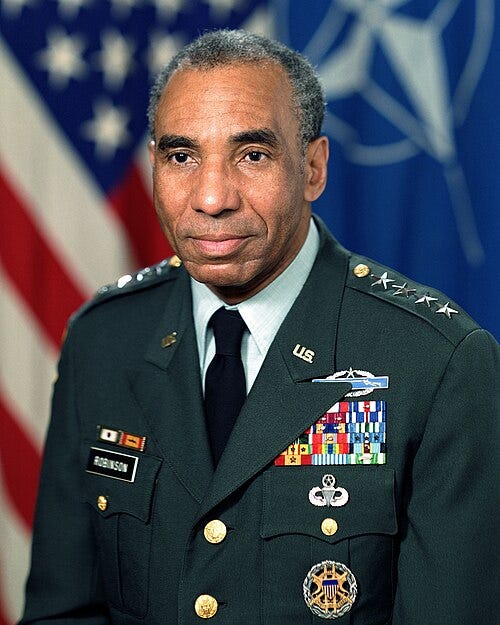
In August 1982, Roscoe Robinson Jr. pinned on his fourth star and became the first African American in the history of the United States Army to reach that rank — a milestone that came 34 years after he entered West Point as one of a small handful of Black cadets, and more than two centuries after Black soldiers first fought in America’s wars without any real chance of leading them.
From St. Louis to West Point
Robinson was born October 11, 1928, in St. Louis, Missouri, and graduated from Sumner High School in 1946. He spent a year at Saint Louis University before winning an appointment to the United States Military Academy at West Point, entering in 1947 and graduating in 1951 with a degree in military engineering — commissioned as a second lieutenant into an Army that would not fully desegregate its ranks in practice for years after Truman’s 1948 executive order on paper ended the policy.
Korea and Vietnam
Robinson deployed to Korea in 1952, serving as a platoon leader, rifle company commander, and later battalion intelligence officer during some of the war’s hardest fighting, and came home with a Bronze Star. He returned to instruct in the Army’s Airborne Department before climbing through a series of staff and command assignments, earning a master’s degree in public and international affairs from the University of Pittsburgh in 1964 and completing the National War College in 1969. By 1967, he was back in combat, commanding the 2nd Battalion, 7th Cavalry Regiment — the same storied unit George Custer once led — through what his commendation called a period of “close and intense combat” in Vietnam. He came out of that command with the Legion of Merit, the Distinguished Flying Cross, eleven Air Medals, and two Silver Stars.
Breaking the Ceiling
The promotions accelerated through the 1970s. Robinson took command of the 2nd Brigade, 82nd Airborne Division at Fort Bragg in 1972, made brigadier general in 1973, and led the Army garrison on Okinawa starting in 1975. In 1976, he was promoted to major general and given command of the 82nd Airborne Division itself, becoming the first African American to lead that storied unit. Four years later, he pinned on his third star as a lieutenant general, commanding U.S. Army forces in Japan and IX Corps. Then, in 1982, came the fourth star and an assignment to match it: U.S. Military Representative to the NATO Military Committee in Brussels, a post that put an American general who had once served in a segregated-in-practice Army at the table representing the United States among its most powerful allies. He held that post until his retirement from the Army in 1985, closing out 34 years of service.
Legacy
Robinson died of leukemia on July 22, 1993, at Walter Reed Army Medical Center, at age 64, and was laid to rest at Arlington National Cemetery. That same year, West Point named him a Distinguished Graduate, and in 2000 the Academy dedicated the General Roscoe Robinson Jr. Auditorium in his honor; Fort Bragg also named a clinic for him.
Robinson had spent much of his later career chairing a formal Army review of the historical performance of African American combat units in Korea, insisting the record be set straight rather than left to old prejudices.
Nearly a decade before Colin Powell became chairman of the Joint Chiefs of Staff, Robinson had already proven a Black officer could rise to the Army’s very top — not by exception, but through command after command, war after war.
Sources:
Roscoe Robinson, Jr. (1928-1993), BlackPast.org
Gen. Roscoe Robinson Jr., Military.com
Roscoe Robinson Jr.: First African American to Become Four-Star General in the U.S. Army, Black Then
Celebrating Black History Month: Reflecting On The Achievements And Leadership Of General Roscoe Robinson, Jr., U.S. Army, Hoover Institution
As a small Substack publication, we could really use your support!
Please enter your email below to support us by subscribing at the free or paid level for less than $10/month.
Independent authors and creative professionals! Please scroll to the “Shameless Plug” at the end to find out about the Pam Speaks 2 You Creative Business Community app for creative branding and marketing.
Today In Black History
In 1884, Black inventor John Parker patented the “Parker Pulverizer,” a screw for tobacco presses.
In 1957, Arkansas Governor Orval Faubus mobilized the National Guard to Central High School in Little Rock, blocking the Little Rock Nine from entering on the eve of the school year.
In 1958, Black inventor Frederick McKinley Jones was granted a patent for a control device for internal combustion engines, part of the innovations behind his refrigeration work and the founding of Thermo King.
In 1966, baseball player Frank Robinson was named MVP (“Most Valuable Player”) for the American League.
In 1975, Joseph Woodrow Hatchett became the first Black state Supreme Court Justice in the South since Reconstruction when he was sworn in for Florida.
Paid subscribers can always leave questions in the comments or email us.
Please consider becoming a paid subscriber for $10/month or less to access all of the articles and other benefits.


If you are an independent author or creative professional, this is your chance to join the Pam Speaks 2 You Creative Business Community, and there’s an app for that!
The Pam Speaks 2 You Apple/iOS app is live!
The Pam Speaks 2 You Google/Android app is live!
You can also access the Pam Speaks 2 You app on the web!