

Issue #1051 Today In Black History Wednesday, July 15, 2026
Please scroll to the end of this post to support us by subscribing at the free or paid level.
Independent authors and creative professionals! Please scroll to the “Shameless Plug” at the end to find out about the Pam Speaks 2 You Creative Business app for creative branding and marketing.
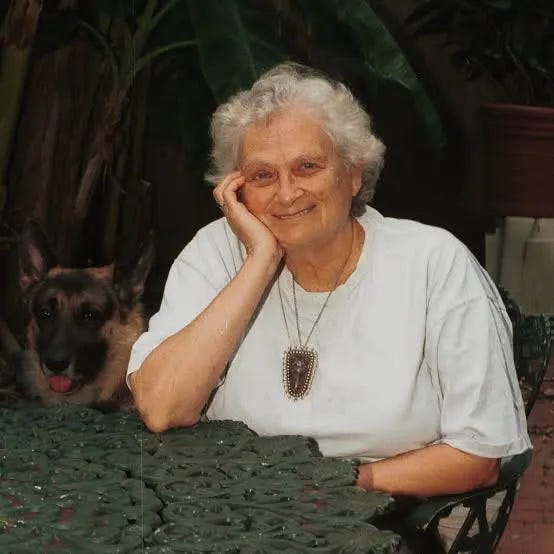
Gwendolyn Midlo Hall spent her life proving that the enslaved were not anonymous. Born June 27, 1929, in New Orleans to Ethel and Herman Midlo, a civil rights and labor attorney, she grew up in a household where justice was a daily conversation rather than an abstraction. That upbringing set the course for everything she did afterward, first as an activist and later as one of the most consequential historians of slavery in the Americas.
As a young woman in the Jim Crow South, Hall put her convictions into action. She helped organize the New Orleans Youth Council, the Young Progressives, the Civil Rights Congress, and the Southern Council for Human Welfare, groups whose interracial membership defied the segregationist norms of her time and place. In 1949 she graduated from Newcomb College with a degree in European and American history, the beginning of an academic career that would eventually take her to Rutgers University, where she taught Latin American and Caribbean history for 25 years and later became professor emerita.
Hall’s defining contribution came from archival work most historians would have found impossibly tedious. Beginning in 1984, she spent years combing through Louisiana’s court records, census rolls, sacramental registers, and notarial documents, piecing together the identities of enslaved people who existed in official records as little more than property listings. In 2000, she released the first version of what became the Afro-Louisiana History and Genealogy database, now widely known as the Louisiana Slave Database. It eventually grew to more than 100,000 records documenting enslaved individuals and free people of color in Louisiana between 1699 and 1820.
The database did something rare in the historiography of slavery: it restored names. For descendants searching for ancestors erased by the domestic slave trade and generations of record loss, Hall’s work became an entry point back into family history that had seemed permanently lost. For scholars, it became a foundational resource for reconstructing the demographic, cultural, and economic realities of colonial Louisiana slavery with a level of specificity previously unavailable.
Hall’s scholarship extended well beyond the database itself. Her 1992 book, “Africans in Colonial Louisiana: The Development of Afro-Creole Culture in the Eighteenth Century,” used the French and Spanish colonial records she uncovered to trace the specific African ethnic origins of enslaved people brought to Louisiana and to examine how those diverse backgrounds fused into a distinct Afro-Creole culture.
The book challenged assumptions about slavery as a monolithic experience and instead showed how African cultural retention shaped Louisiana’s language, religion, music, and social structure in ways still visible today. She also wrote “Social Control in Slave Plantation Societies,” a comparative study of Louisiana and the Caribbean that broadened her reputation beyond a single region.
Hall’s influence reached historians, genealogists, and descendant communities alike. Her insistence on primary-source rigor, combined with her belief that enslaved people deserved to be studied as individuals rather than statistics, reshaped how scholars approach the archival record of slavery. Institutions and researchers who have built on her database, including the broader Slave Biographies project, continue to extend her methodology to other regions of the enslaved Atlantic world.
Gwendolyn Midlo Hall died on August 29, 2022, at the age of 93. She left behind a body of work that did more than document slavery’s brutality. It gave names, families, and histories back to people the historical record had tried to erase.
Today In Black History
In 1868, the 14th Amendment, validating full citizenship rights for all persons born or naturalized in the United States, was ratified.
In 1942, the Women’s Army Auxiliary Corps (WAC) was formed and accepted Black women.
In 1967, over 1,000 people attended the first Black Power Conference in Newark, New Jersey.
In 1976, Hank Aaron hit his 755th and last home run.
Paid subscribers can always leave questions in the comments or email us.
Please consider becoming a paid subscriber for $10/month or less to access all of the articles and other benefits.


If you are an independent author or creative professional, this is your chance to join the Pam Speaks 2 You Creative Business Community, and there’s an app for that!
The Pam Speaks 2 You Apple/iOS app is live!
The Pam Speaks 2 You Google/Android app is live!
You can also access the Pam Speaks 2 You app on the web!