

Issue #1067: Today In Black History, Wednesday, August 26, 2026
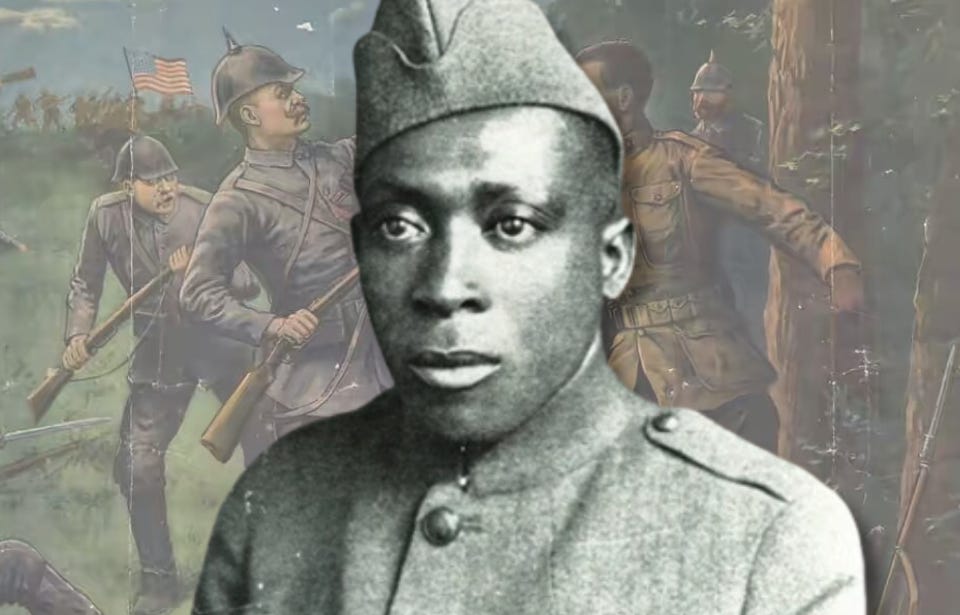
Henry Johnson was born around 1892 in Winston-Salem, North Carolina, and later settled in Albany, New York, where he worked as a soda mixer, laborer, and railway station porter. In 1917, as the United States entered World War I, Johnson enlisted in the all-Black 15th New York National Guard Regiment. It would soon be redesignated the 369th United States Infantry Regiment — the unit history would remember as the Harlem Hellfighters.
The Hellfighters trained for combat like any American soldiers, but the U.S. Army had no intention of letting them fight alongside white troops. Rather than integrate them into American divisions, the Army handed the 369th over to the French Army, which was desperate for manpower and far less concerned with the color line. The French issued the regiment its own rifles, helmets, and equipment, and the men of the 369th spent more consecutive days in front-line combat than any other American regiment in the war—191 days. They never lost a foot of ground, and not a single man was taken prisoner. The regiment’s band, led by Lieutenant James Reese Europe, is widely credited with introducing jazz to European audiences during the war, seeding a musical influence that would echo across the continent for decades.
Henry Johnson’s defining moment came on the night of May 15, 1918, in France’s Argonne Forest. Standing sentry duty with fellow private Needham Roberts, Johnson came under attack from a German raiding party of more than a dozen soldiers. Roberts was badly wounded early in the fight. Rather than retreat, Johnson held his ground, firing his rifle until he ran out of ammunition, then throwing grenades, and finally fighting hand-to-hand with a bolo knife when the Germans closed in — killing several attackers and wounding others, preventing Roberts from being captured. Johnson suffered 21 wounds but survived, and the raiding party retreated.
The French government awarded Johnson its Croix de Guerre with bronze palm, making him one of the first Americans of any race to receive the honor in the war. German soldiers reportedly began calling him “Black Death.” Journalist Irvin S. Cobb, who had arrived in France skeptical of Black soldiers’ abilities, wrote an account of Johnson’s heroism that circulated widely in the American press and helped make him briefly famous.
That fame did not translate into recognition or support at home. Johnson returned to the United States with wounds that left him unable to continue his old work, but the Army denied him a disability pension and even a Purple Heart, and never entered his combat wounds in his official record. He struggled with poverty and declining health for the rest of his life and died in 1929, largely forgotten, at just 32 years old. He was buried with military honors in Arlington National Cemetery, but the honors due his actual battlefield service were still decades away.
The reckoning came slowly. Johnson received a posthumous Purple Heart in 1996, the Distinguished Service Cross in 2002, and finally the Medal of Honor in 2015, presented by President Barack Obama, who noted that Johnson had been denied the nation’s highest military honor for nearly a century largely because of his race.
Today, Henry Johnson and the Harlem Hellfighters stand as one of the most striking examples in American history of extraordinary valor met with willful national neglect — and of the long, often posthumous fight to set that record straight.
Sources:
Harlem Hellfighter Henry Johnson awarded a posthumous Medal of Honor | HISTORY
Harlem Hellfighter Hero: Henry Johnson | America Comes Alive
WWI ‘Harlem Hellfighter’ Henry Johnson to Receive Medal of Honor | NBC News
As a small Substack publication, we could really use your support!
Please scroll to the end of this post , or enter your email below to support us by subscribing at the free or paid level for less than $10/month.
Independent authors and creative professionals! Please scroll to the “Shameless Plug” at the end to find out about the Pam Speaks 2 You Creative Business Community app for creative branding and marketing.
Today In Black History
In 1943, William Dawson was elected as the first Black Democratic Party vice presidential candidate.
In 1947, Dan Bankhead became the first Negro League pitcher in Major League Baseball.
In 1968, Rev. Channing E. Phillips of Washington, D.C., was the first Black nominated for president by a major party at the Democratic Convention in Chicago, IL.
In 1968, Julian Bond was nominated as the vice-presidential candidate at the Democratic Convention in Chicago, IL, but he withdrew his name because, at age 28, he did not meet the Constitutional age of 35.
Paid subscribers can always leave questions in the comments or email us.
Please consider becoming a paid subscriber for $10/month or less to access all of the articles and other benefits.


If you are an independent author or creative professional, this is your chance to join the Pam Speaks 2 You Creative Business Community, and there’s an app for that!
The Pam Speaks 2 You Apple/iOS app is live!
The Pam Speaks 2 You Google/Android app is live!
You can also access the Pam Speaks 2 You app on the web!