Issue #1,014 Today In Black History, Wednesday, April 8, 2026
Our goal is to make “We Are Speaking” a best-selling publication by July 1, 2026, increasing our reach and influence! To achieve our goal, we will need 15 new paid subscribers every week, or 5 new paid subscribers for each of the three days per week we publish. If you value our publication, please consider becoming a paid subscriber for just $5/month or $50/year. We appreciate your financial support! We appreciate your financial support!
I am a retired educator of all grades from Pre-K through university level, and I primarily taught English, government, and history. However, not only did I not learn about the Black Seminoles in school, but I also did not teach them, because I did not know about them.
I hope this post will help you learn about this important topic in American history.
John Horse stands as one of the most remarkable yet often overlooked figures in American military history—a man who led warriors across continents, commanded respect from diverse peoples, and fought tirelessly for freedom against overwhelming odds.
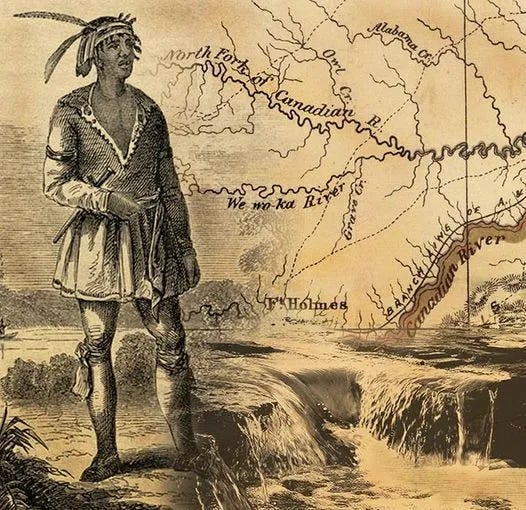
John Horse, also known as Juan Caballo, Juan Cavallo, John Cowaya, and Gopher John, was a man of mixed African and Seminole ancestry who fought alongside the Seminoles in the Second Seminole War in Florida. His surname “Horse” is believed to have been a translation of Cavallo (or Caballo, the Spanish word for horse).
Born around 1812 in Florida to a Black Seminole family, John Horse would become a legendary military strategist whose influence extended far beyond the borders of the United States. He rose to prominence in the third year of a seven-year war when the first generation of Black Seminole leaders was largely decimated, and the charismatic Seminole war leader Osceola was taken prisoner by the American military commander.
In 1818, the American General Andrew Jackson invaded the area, scattering the tribal peoples and their Black allies in the region. Jackson also destroyed settlements and seized Blacks from among the Seminole for removal to the north and returned to plantation slavery.
During the Second Seminole War (1835-1842), John Horse emerged as a principal leader of the Black Seminoles, a distinct community of African Americans who had found refuge among the Seminole Nation. Unlike many enslaved African Americans of his era, Horse lived as a free man within Seminole society, where Black Seminoles held a unique status—neither fully enslaved nor fully free, but occupying a space that allowed greater autonomy than available elsewhere in the American South.
Horse learned to read and write and acquired linguistic skills in English, Spanish, and the Hitchiti tongue spoken by the Oconee and many other Seminole bands. He was one of Osceola’s main translators when dealing with the Americans.
Horse’s military genius became evident in his strategic planning and tactical innovations. He worked alongside Osceola, the renowned Seminole resistance leader, coordinating military operations against superior U.S. forces.
What set Horse apart was his ability to organize and inspire fighters across racial and ethnic lines. He successfully unified Black Seminoles and Native Seminoles under a common cause, demonstrating leadership qualities that transcended the racial divisions so prevalent in nineteenth-century America. His understanding of guerrilla warfare and his deep knowledge of Florida’s terrain proved invaluable in frustrating American military campaigns.
When the U.S. government began enforcing Indian Removal policies designed to force southeastern tribes westward along the tragic Trail of Tears, John Horse recognized the existential threat to his people.
Despite their remarkable resistance, the Seminoles faced an enemy with seemingly unlimited resources. After years of brutal conflict and broken treaties, John Horse made the difficult decision to lead his people west.
In 1838-1839, he guided approximately 1,500 Black Seminoles on a forced march to Oklahoma, enduring disease, starvation, and violence along the way. Many perished during this journey, which ranks among the most harrowing chapters of American Indian removal history.
However, Horse’s story did not end in Oklahoma. Recognizing that even Indian Territory offered limited safety for his people, he embarked on an even more ambitious undertaking. In 1849-1850, he led a group of Black Seminoles south across Texas toward Mexico, seeking sanctuary in a foreign land.
This remarkable migration involved dangerous river crossings and navigation through hostile territory, yet Horse successfully brought his followers to Mexico, where they established settlements and found the freedom that the United States had denied them.
In Mexico, John Horse continued his military service, eventually joining the Mexican army and rising to the rank of Colonel. He established a settlement called Nacimiento de los Negros and became a trusted military advisor, continuing to lead warriors in defense of Mexican territories against Apache and Comanche raids. His reputation as a brilliant military strategist earned him respect throughout the region.
John Horse’s legacy exemplifies the courage and ingenuity of Black Seminoles, who created and defended their own autonomous space within American history despite systemic oppression.
Today In Black History
In 1924, South Africa passed the Industrial Conciliation Act No. 11 to provide for job reservation for whites only, exclude Blacks from membership in registered trade unions, and prohibit the registration of Black trade unions.
In 1953, Jomo Kenyatta, the founding father of the African nation of Kenya, was convicted of involvement with the Mau Mau rebellion and sentenced to 7 years in jail.
In 1960, the U.S. Senate passed a Civil Rights bill that included measures against discriminatory voting practices.
In 1974, Hank Aaron hit his 715th home run, breaking Babe Ruth’s major league record.
In 1975, baseball outfielder Frank Robinson was named manager of the Cleveland Indians, becoming the first Black manager in Major League Baseball history.
Our goal is to make “We Are Speaking” a best-selling publication by July 1, 2026, increasing our reach and influence! To achieve our goal, we will need 15 new paid subscribers every week, or 5 new paid subscribers for each of the three days per week we publish. If you value our publication, please consider becoming a paid subscriber for just $5/month or $50/year. We appreciate your financial support! We appreciate your financial support!
You are also welcome to view “We Are Speaking” in Substack Notes. You can also read other Substack publications without subscribing to them when you join Notes.