

Issue #1076: Today In Black History, Monday, September 23, 2026
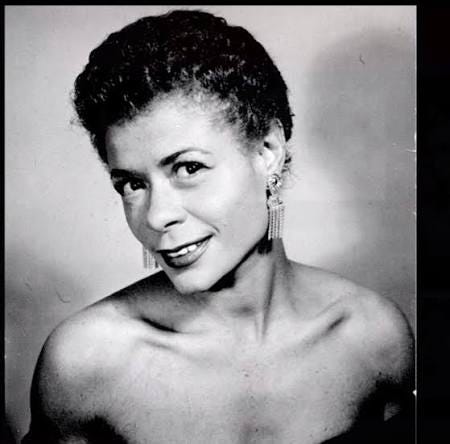
When most people picture Pilates today, they see sleek studios and reformer classes in every city. Few know that one of the people who shaped the method was a Black woman from Boston who came to it by way of Broadway, a knee injury, and a stubborn refusal to stop moving. Her name was Kathy Stanford Grant, and the Pilates world still calls her one of its elders.
Grant was born in Boston on August 1, 1921. At the age of nine, she became the first Black student to take ballet classes at the Boston Conservatory of Music. Talented and determined, she spent her teenage summers studying dance at Carnegie Hall in New York. By the mid-1940s, she had moved to the city for good, working as a chorus girl and dance captain at Harlem’s Zanzibar Club and sharing stages with Bill “Bojangles” Robinson, Pearl Bailey, and Cab Calloway.
In 1947, she joined the cast of Finian’s Rainbow, often described as Broadway’s first integrated production. More stage work followed, including Kiss Me, Kate and Carmen Jones, along with international tours through Europe and beyond. She also performed in New York with Arthur Mitchell and Donald McKayle, two giants of Black dance.
Then, in 1954, knee surgery after a performance injury slowed her recovery and left her uncertain. The dancer Pearl Lang sent her to Joseph Pilates, the German-born trainer whose system of “Contrology” was quietly popular among New York dancers. That referral changed her life.
Grant logged more than 2,000 hours of training under Joseph Pilates. In the 1960s, she and Lolita San Miguel became the only two people he ever certified to teach his method, through a program offered with the State University of New York. That distinction alone would have secured her place in fitness history. Grant did far more with it.
She taught alongside Carola Trier, another early Pilates teacher, and in 1972 opened the Pilates studio at the Henri Bendel department store in Manhattan. In 1988, she moved her studio to New York University’s Tisch School of the Arts, where she trained generations of dancers and actors and became the first Black woman to run a Pilates program of that stature.
Her influence reached well beyond the studio. She was the first administrative director of the Dance Theatre of Harlem, directed the Clark Center for the Performing Arts, and became the first African American appointed to the National Endowment for the Arts dance panel. She traveled to Guinea as a cultural consultant on a Harry Belafonte project and helped organize the Dance Black America conference in 1983.
What set Grant apart as a teacher was how she saw each person. Students said she could spot a problem from across the room just by listening to the rhythm of their movement. Instead of forcing everybody into one fixed routine, she adapted the exercises to the person, creating props and variations that met students where they were. Many of her modifications are still taught today. She warned teachers against getting comfortable: “When you think you know Pilates, you should stop teaching. It means you are not present with the person in front of you.”
She kept teaching into her eighties, giving master classes around the country, and received a lifetime achievement award in 2003. Kathy Stanford Grant died in New York City on May 27, 2010, at 88.
Her legacy lives on in the method itself. Each time a Pilates instructor adjusts an exercise to fit the body in front of them, they are practicing what she taught. And each time a Black woman walks into a studio and sees herself there, she is walking a path Grant opened decades ago.
Sources
Kathy Stanford Grant: The Black Woman Who Helped Revolutionize Pilates, The Root
A Strong Presence: Memories of Kathy Grant, IDEA Health & Fitness
How She Built This: Kathy Stanford Grant, BET
As a small Substack publication, we could really use your support!
Please enter your email below to support us by subscribing at the free or paid level for less than $10/month.
Independent authors and creative professionals! Please scroll to the “Shameless Plug” at the end to find out about the Pam Speaks 2 You Creative Business Community app for creative branding and marketing.
Today In Black History
In 1829, David Walker of Massachusetts, abolitionist and author, wrote his tract, “Walker’s Appeal to the Colored People of the World,” denouncing slavery and calling for Blacks to mobilize and rise up against it.
In 1868, the Opelousas Massacre occurred in Louisiana, resulting in the deaths of around 300 Black Americans.
In 1895, three Black Baptist groups merged and established the National Baptist Convention at a meeting in Atlanta.
In 1961, playwright Ossie Davis’s “Purvis Victorious” opened on Broadway.
In 1962, Governor Barnett was found guilty of civil contempt of the federal court. The United States Court of Appeals for the Fifth Circuit ordered Barnett to purge himself of contempt or face arrest and a $ 10,000-a-day fine.
In 1967, Walter Washington took office as the first mayor of Washington, D.C.
In 1972, the Secretary of the Army cleared the military records of 167 Black soldiers who were dishonorably discharged in 1906 because they refused to identify alleged participants in the Brownsville Raid.
In 1991, the National Civil Rights Museum officially opened at the Lorraine Motel in Memphis, TN, where Dr. Martin Luther King was assassinated in 1968.
In 2000, Venus and Serena Williams won the Olympic Gold Medal in women’s doubles tennis in Sidney, Australia. With this win, Venus Williams became the only woman to win gold in singles and doubles since 1924.
Paid subscribers can always leave questions in the comments or email us.
Please consider becoming a paid subscriber for $10/month or less to access all of the articles and other benefits.



If you are an independent author or creative professional, this is your chance to join the Pam Speaks 2 You Creative Business Community, and there’s an app for that!
The Pam Speaks 2 You Apple/iOS app is live!
The Pam Speaks 2 You Google/Android app is live!
You can also access the Pam Speaks 2 You app on the web!