

Issue #1060 Today In Black History Wednesday, August 12, 2026
As a small Substack publication, we could really use your support!
Please scroll to the end of this post to support us by subscribing at the free or paid level for less than $10/month.
Independent authors and creative professionals! Please scroll to the “Shameless Plug” at the end to find out about the Pam Speaks 2 You Creative Business Community app for creative branding and marketing.
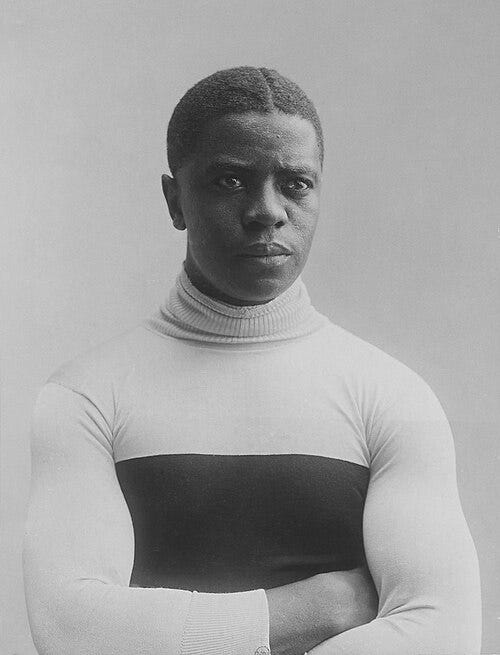
Marshall Walter “Major” Taylor became the fastest man on two wheels at a time when much of the country was working to make sure he never got the chance. Born November 26, 1878, in Indianapolis, Indiana, Taylor grew up doing bike tricks outside a local shop while dressed in a military-style uniform for advertising, which is how he earned the nickname that stayed with him for life. The shop owner recognized his talent early, and by his teens Taylor was already outracing adults.
Breaking Into a Segregated Sport
Taylor’s rise came just as competitive cycling was one of the most popular — and most lucrative — spectator sports in America. It was also hostile territory for a Black athlete. The League of American Wheelmen, cycling’s governing body, voted in 1894 to bar Black membership outright, and Taylor spent much of his career facing boycotts from white riders, exclusion from Southern tracks, and outright violence, including being physically attacked on the track by a competitor in Boston. He relocated from Indianapolis to Worcester, Massachusetts, seeking a more tolerant training ground, and it became his lifelong home base.
None of it slowed him down. In 1896, at eighteen, Taylor won his first major race, a one-mile sprint at a prestigious meet in Massachusetts. Over the next few years he shattered records across nearly every sprint distance, from a quarter-mile to two miles, and by 1898 he held seven world records simultaneously.
World Champion
In 1899, competing in Montreal, Taylor won the world one-mile track cycling championship, making him the second Black athlete to win a world title in any sport and the first Black cyclist to do so — a full decade before Jack Johnson broke boxing’s color line. The following year he won the U.S. sprint championship. He raced across Europe and Australia to massive crowds, often earning more in a single European tour than most Americans made in years, and was celebrated abroad in ways he rarely was at home.
Taylor was also known for a conviction that set him apart from most professional athletes of his era: a devout Baptist, he refused to race on Sundays throughout his career, even when it cost him major purses and titles he might otherwise have claimed.
Decline and Rediscovery
Taylor retired from racing in 1910, worn down by the physical toll of competing and the constant strain of racism both on and off the track. He invested his winnings in business ventures that failed during the Great Depression, and by the early 1930s he was destitute, selling copies of his self-published 1928 autobiography, “The Fastest Bicycle Rider in the World,” door to door in Chicago. He died alone on June 21, 1932, at Cook County Hospital, and was buried in an unmarked grave in a segregated section of a Chicago cemetery.
Legacy
Taylor’s story might have ended there had a group of former professional cyclists, organized with support from Schwinn Bicycle Company executive Frank W. Schwinn, not raised money in 1948 to give him a proper burial with a new headstone. Today, Major Taylor is recognized as one of the first Black athletes to achieve international sports stardom, a trailblazer whose success under relentless hostility opened doors later walked through by Jackie Robinson, Jesse Owens, and generations of Black athletes who followed. Cycling clubs across the country still carry his name in tribute to a champion the sport tried, and failed, to keep out.
Sources: Wikipedia; Britannica; Biography.com; National Endowment for the Humanities; Major Taylor Association
Today In Black History
In 1794, Absalom Jones and his followers dedicated the African Church of St. Thomas in Philadelphia, and affiliated with the Protestant Episcopal Church after they were thrown out of the white church to which they originally belonged because they were praying in the same section as the white members.
In 1890, the Mississippi Constitutional Convention began the systematic exclusion of Blacks from political life in the South, using literacy tests and other restrictions.
In 1922, the Washington, D.C. home of Frederick Douglass was declared a national shrine.
In 1941, Madame Lillian Evanti, internationally renowned opera singer, founded the National Negro Opera Company.
Paid subscribers can always leave questions in the comments or email us.
Please consider becoming a paid subscriber for $10/month or less to access all of the articles and other benefits.


If you are an independent author or creative professional, this is your chance to join the Pam Speaks 2 You Creative Business Community, and there’s an app for that!
The Pam Speaks 2 You Apple/iOS app is live!
The Pam Speaks 2 You Google/Android app is live!
You can also access the Pam Speaks 2 You app on the web!