Issue #1,101 Today In Black History, Wednesday, November 18, 2026
Please enter your email below to support us by subscribing at the free or paid level for less than $10/month.
We Are Speaking is a small reader-supported publication. To receive new posts and support our work, consider subscribing at the free or paid level.
Independent authors and creative professionals! Please scroll to the “Shameless Plug” at the end to find out about the Pam Speaks 2 You Creative Business Community app for creative branding and marketing.
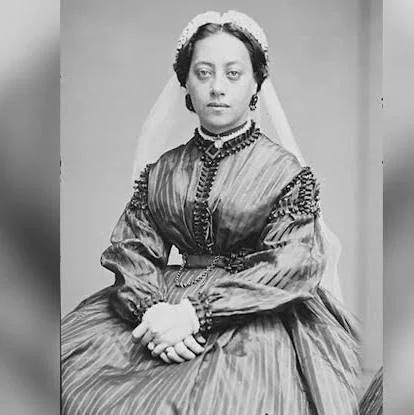
Today In Black History: Mary Ellen Pleasant, the Mother of Civil Rights in California
Long before Rosa Parks refused to give up her seat in Montgomery, a Black woman in San Francisco took a streetcar company to court and won. Her name was Mary Ellen Pleasant, and her life reads like a novel: abolitionist, Gold Rush entrepreneur, Underground Railroad operative, financier, and one of America’s first Black millionaires. She was also one of the most slandered women of her century, and that is part of why so few people know her name today.
Humble and Uncertain Beginnings
Pleasant was born around 1814, though even her birth year is disputed. She gave different accounts of her origins over her lifetime, a habit that may have been a survival strategy in an era when a Black woman’s freedom could be challenged at any moment. What is clear is that as a child she was sent to Nantucket, Massachusetts, where she worked as a bound servant for a Quaker family. There, she absorbed the community’s abolitionist politics and developed the sharp business sense that would define her life.
She later married James Smith, a wealthy abolitionist, and together they helped people escape slavery through the Underground Railroad. When Smith died, he left her a substantial inheritance and a mission to keep using it for the cause of freedom.
Building a Fortune in Gold Rush San Francisco
Pleasant arrived in San Francisco in the early 1850s, when the Gold Rush had turned the city into a boomtown. She began by working as a cook and housekeeper for wealthy white households, which gave her access to bankers’ and businessmen’s conversations. She listened carefully, invested wisely, and quietly built an empire of laundries, boarding houses, restaurants, and real estate. Working with her business partner Thomas Bell, she became a powerful financial force in the city. At its height, her fortune was estimated in the millions.
She used that wealth with purpose. Pleasant hired formerly enslaved people, found them jobs and housing, and sheltered people who had escaped bondage. She supported legal fights for Black Californians and helped push for the 1863 repeal of the state law that barred Black people from testifying in court against white people.
“A Friend of John Brown”
Pleasant later said that she gave money to John Brown before his 1859 raid on Harpers Ferry, the failed uprising meant to spark a revolt against slavery. Historians have never fully confirmed the details, but she was proud of the connection. Her gravestone in Napa, California, bears the words she requested: “She was a friend of John Brown.”
Taking on the Streetcars
Her most lasting legal victory came after the Civil War. In 1866, Pleasant and other Black women were refused service or removed from San Francisco streetcars. Rather than accept it, she sued. Her case, Pleasant v. North Beach & Mission Railroad Company, went all the way to the California Supreme Court in 1868 and helped end segregation on the city’s public transportation. That victory is why she is remembered as the “Mother of Civil Rights in California.”
Slander and Survival
Success made her a target. Newspapers mocked her with the racist nickname “Mammy Pleasant” and spread wild rumors of voodoo and scandal, especially after Thomas Bell’s death in 1892 drew her into bitter legal battles with his family. She lost much of her fortune in court and died in January 1904.
Her Legacy
Today, a small memorial park lined with eucalyptus trees she planted marks the site of her former mansion in San Francisco. Historians continue to recover her story from the lies told about her. Mary Ellen Pleasant proved that economic power could be a weapon for freedom, and that one determined woman could change the law. We are still riding on the road she paved.
In 1977, Robert E. Chambliss, a white supremacist, was convicted of first-degree murder in the 1963 bombing of the 16th Street Baptist Church in Birmingham, AL. Four little girls, Addie Mae Collins, Carol Robertson, Denise McNair, and Cynthia Wesley, were killed in the racist attack.
In 1978, the Jonestown massacre occurred. Over 900 people, mostly American Blacks, were killed in a mass suicide/murder in Jonestown, Guyana, by drinking poisoned FlavorAid (not Kool-Aid). The deceased were followers of Jim Jones, a white cult leader who claimed he was God.
In 1992, filmmaker Spike Lee’s epic motion picture, “Malcolm X,” a film about the life of Malcolm X, opened to a nationwide audience.
Paid subscribers can always leave questions in the comments or email us.
Please consider becoming a paid subscriber for $10/month or less to access all of the articles and other benefits.
If you are an independent author or creative professional, this is your chance to join the Pam Speaks 2 You Creative Business Community, and there’s an app for that! We have 5 eBooks and 5 courses, plus networking communities designed specifically for you in the Branding and Marketing Academy!