Issue #1,085 Today In Black History, Monday, October 12, 2026
Please enter your email below to support us by subscribing at the free or paid level for less than $10/month.
We Are Speaking is a small reader-supported publication. To receive new posts and support our work, consider subscribing at the free or paid level.
Independent authors and creative professionals! Please scroll to the “Shameless Plug” at the end to find out about the Pam Speaks 2 You Creative Business Community app for creative branding and marketing.
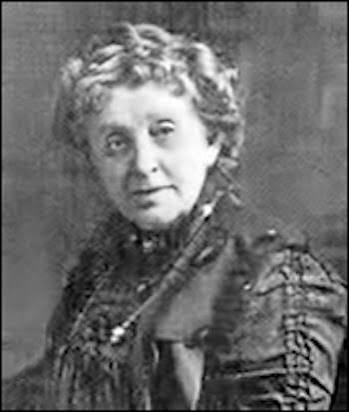
The next time you press the small button above your airplane seat and a flight attendant appears, think of Miriam Benjamin. In 1888, this Black schoolteacher patented a chair that let a seated person summon help with the push of a button. She became one of the first Black women in America to hold a patent, and her idea still rings, quietly, in places she never could have imagined.
A Charleston Girl Raised in Boston
Miriam Elizabeth Benjamin was born on September 16, 1861, in Charleston, South Carolina, just as the Civil War began. Her mother, Eliza Hopkins Benjamin, was a free woman of color. Her father, Francis Benjamin, was of Jewish descent and had left the household by 1870.
In 1872, Eliza moved her children to Boston, a city some Black writers then called “the Mecca of the Negro Race.” It was a good bet. Miriam graduated from Girls’ High School in 1881 and went on to teach at the Stanton Institute in Jacksonville, Florida. She later taught in the segregated public schools of Washington, D.C. She also passed the civil service exam and worked as a clerk in several federal departments, at a time when few Black women held government jobs of any kind.
The Gong and Signal Chair
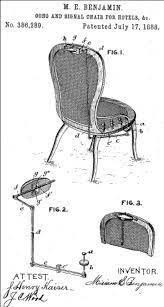
While living in Washington, Benjamin noticed a common problem. Hotel guests and diners had to clap, shout, or wave to get a waiter’s attention. Her answer was the “Gong and Signal Chair for Hotels.” A guest pressed a small button on the chair. A gong sounded for the attendant, and a signal on the chair’s back showed exactly who needed service.
The U.S. Patent Office granted her Patent No. 386,289 on July 17, 1888. She is widely recognized as the second African American woman to receive a U.S. patent.
Benjamin didn’t stop at hotels. She saw that her chair could help lawmakers call the young pages who ran errands on the House floor, and she lobbied Congress to adopt it.
In 1895, the U.S. House of Representatives installed a similar, more elaborate call system. That same year, her chair was displayed in the “Negro Building” at the Cotton States and International Exposition in Atlanta.
A Woman of Many Talents
Invention was only one of Benjamin’s gifts. She studied medicine at Howard University and trained in law. By 1900, she called herself a “solicitor of patents,” and she handled patent work for her brothers Lyde and Edgar, who were inventors too. Historians at Boston’s Trinity Church believe she may have been the first Black woman to work as a patent attorney.
She kept inventing. She reportedly patented a pinking device for dressmakers in 1903. In 1917, she patented a shoe sole designed to help regulate foot temperature.
She was also a composer. Writing under the pen name “E. B. Miriam,” she published songs and marches. John Philip Sousa’s band reportedly played her “Boston Elite Quickstep,” and Theodore Roosevelt’s 1904 presidential campaign used one of her pieces.
In 1920, Benjamin returned to Boston for good. She lived and worked with her brother Edgar, a lawyer and community builder, and cared for their mother. She never married. Miriam Benjamin died on January 2, 1947, and her funeral was held at Trinity Church.
A Legacy That Still Answers the Call
Benjamin’s chair is often named as an ancestor of the call buttons used on airplanes and in hospitals today. Her bigger legacy may be the example she set. In an age that offered Black women little beyond domestic work, she taught, invented, practiced law, wrote music, and lobbied the U.S. Congress. She didn’t wait to be noticed. She built a way to make sure people heard her.
Please consider becoming a paid subscriber for $10/month or less to access all of the articles and other benefits.
If you are an independent author or creative professional, this is your chance to join the Pam Speaks 2 You Creative Business Community, and there’s an app for that! We have 5 eBooks and 5 courses, plus networking communities designed specifically for you in the Branding and Marketing Academy!