

Issue #967 Today In Black History, Monday, December 8, 2025
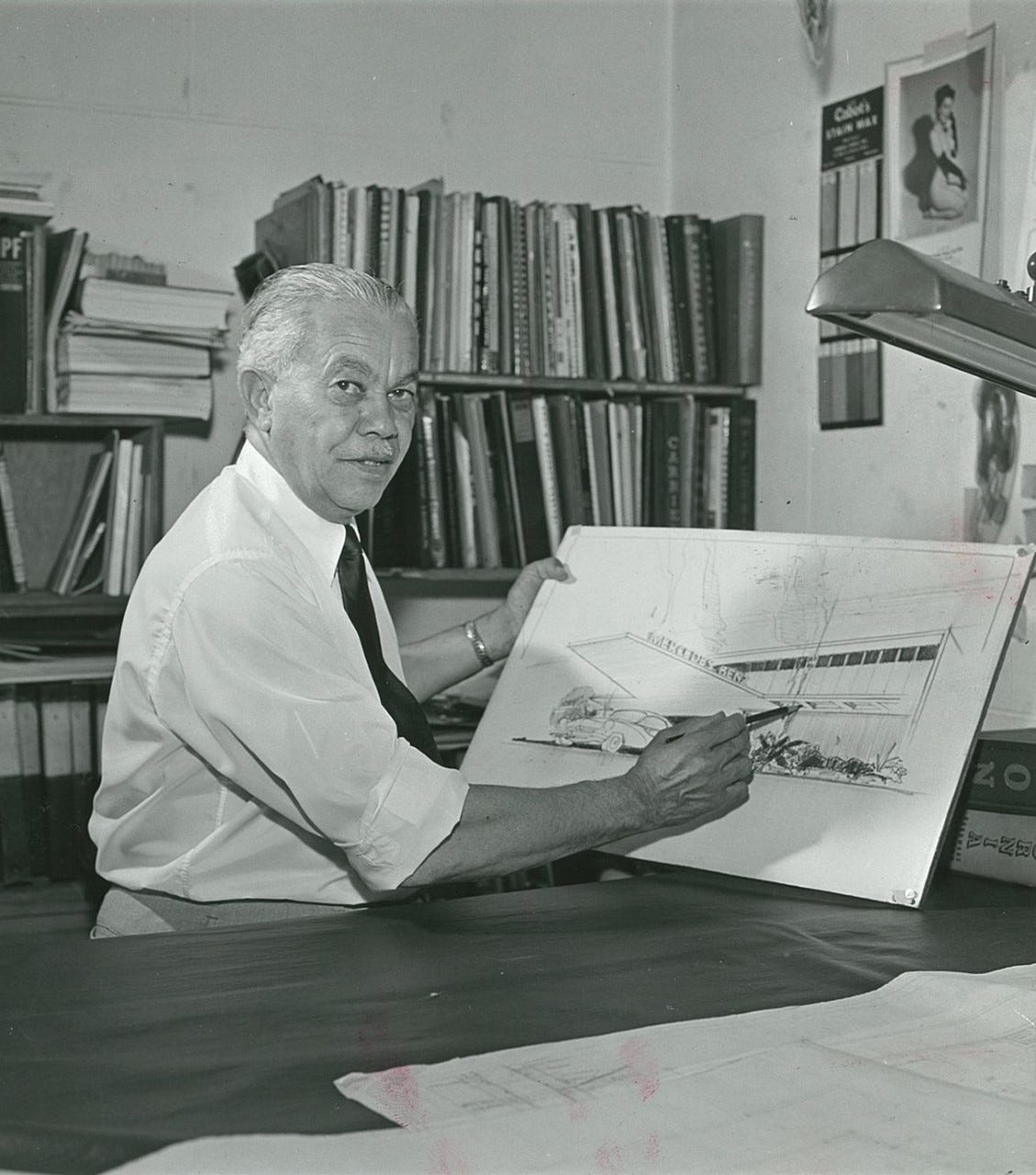
Born in Los Angeles on February 18, 1894, Paul Revere Williams became one of the most prolific and celebrated architects of the twentieth century. Nicknamed “Architect to the Stars,” he designed approximately 3,000 buildings throughout his five-decade career—particularly in Southern California.
Paul Revere Williams’ life began with profound tragedy. Both of his parents, Chester Stanley and Lila Wright Williams, died from tuberculosis when Paul was only four years old. Orphaned at such a young age, Williams was raised by his maternal grandmother in Los Angeles.
During Williams’ childhood in early twentieth-century Los Angeles, he was one of the few Black children in his elementary school class. This experience helped Williams to develop the resilience and determination that would define his entire career.
Williams attended the Los Angeles School of Art and Design, the Los Angeles branch of the prestigious New York-based Beaux-Arts Institute of Design, and ultimately the University of Southern California, where he studied architectural engineering. In 1919, he graduated from USC with an architecture degree, and in 1921, he became the first African American to be certified as an architect west of the Mississippi River.
In the 1920s, Williams’ early work included residential designs that caught the attention of prominent clients.
By the 1940s, he had become one of the most sought-after architects in Los Angeles. His client list read like a who’s who of Hollywood: Frank Sinatra, Lucille Ball and Desi Arnaz, Lon Chaney Sr., Barbara Stanwyck, and Charles Correll all commissioned Williams to design their homes. This association with Hollywood celebrities earned him the nickname “Architect to the Stars.”
Williams was equally comfortable designing in historical styles and modernist approaches. His Spanish Colonial Revival homes were as authentic and beautifully executed as his modernist designs.
He understood the unique opportunities offered by Southern California’s climate and designed homes that fully leveraged natural light, ventilation, and the ability to live both indoors and outdoors.
While Williams is perhaps best known for his residential designs for Hollywood celebrities, his body of work extended far beyond luxury homes. He designed commercial buildings, institutional structures, civic buildings, and public facilities throughout California, Nevada, Hawaii, Oregon, New York, Tennessee, Washington, D.C., and even in South America.
One of his most iconic works is the Theme Building at Los Angeles International Airport, designed in 1959 in collaboration with architects William Pereira and Welton Becket. The Theme Building’s distinctive architecture has become one of the most recognizable structures in Los Angeles and a symbol of mid-century modernism.
Despite his extraordinary success, Williams faced persistent racial discrimination throughout his career. Most troublingly, he was often not welcome in the buildings he designed. There are documented instances where Williams, having designed a building, was denied entry because of his race. He was sometimes required to use separate entrances or was barred from certain areas of buildings he had created.
Williams’ approach to confronting racism was strategic and sophisticated. He understood that his best response to discrimination was to continue to excel. By producing work of undeniable quality and by building relationships with powerful clients and colleagues, he gradually changed perceptions and created space for other Black architects to enter the profession.
In 1957, Williams was elected a Fellow of the American Institute of Architects (FAIA), one of the profession's highest honors. This recognition acknowledged his extraordinary contributions to architecture and his status as one of the most important architects of his generation.
Williams continued to practice architecture until his death on January 23, 1980, at the age of 85.
In 2017, more than three decades after his death, Williams was posthumously awarded the AIA Gold Medal, the American Institute of Architects’ highest honor. This award recognizes individuals whose work has had a lasting influence on the theory and practice of architecture.
Today, Paul Revere Williams’ legacy is being actively preserved and studied through the Paul Revere Williams Project, a comprehensive initiative dedicated to increasing knowledge about the architect and his work. The project facilitates access to information about his buildings, presents exhibitions, and publishes new research about his career. His granddaughter, Karen Hudson, has authored three books about the architect and has been instrumental in ensuring that his contributions are properly documented and celebrated.
The project has created tools like the Paul Revere Williams Career Mapper, a web-based data visualization tool that allows researchers to explore Williams’ projects by date, location, building type, and client type. This resource enables scholars, students, and the general public to understand the full scope and diversity of his work.
Today In Black History
In 1863, President Abraham Lincoln issued his Proclamation of Amnesty and Reconstruction to restore the Confederate States to the Union.
In 1850, abolitionist Lucy Stanton Day Sessions was the first African-American woman to complete a four-year course of study at a university, finishing the Ladies Literary Course at Oberlin College.
In 1987, Kurt Schmoke became the first African American mayor of Baltimore, MD.
