

Issue #1057 Today In Black History Monday, August 3, 2026
Please scroll to the end of this post to support us by subscribing at the free or paid level.
Independent authors and creative professionals! Please scroll to the “Shameless Plug” at the end to find out about the Pam Speaks 2 You Creative Business Community app for creative branding and marketing.
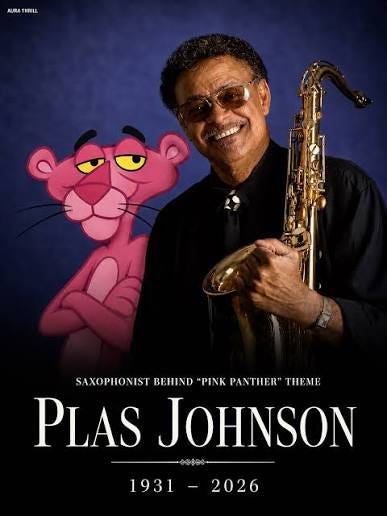
Millions of people who could never pick his face out of a crowd know his sound by heart. Plas John Johnson, Jr. was born July 21, 1931, in Donaldsonville, Louisiana, into a musical household — his father played banjo and later saxophone, his mother sang and played piano. Johnson was singing harmonies with his siblings by age four, and once his father bought him a soprano saxophone, he taught himself to play, later moving to alto and tenor. He and his pianist brother Ray began recording as the Johnson Brothers in New Orleans in the late 1940s, and by 1951 Plas was touring with R&B singer Charles Brown.
From New Orleans to the L.A. Studios
After serving in the Army, Johnson and his brother relocated to Los Angeles in 1954, and Plas quickly became one of the busiest session musicians in the country. Bandleader and producer Maxwell Davis, an early champion, hired Johnson to cover his own saxophone parts so Davis could focus on producing for Modern Records. From there, Johnny Otis and Capitol Records executive Dave Cavanaugh brought Johnson into the Capitol fold, where he played behind Nat King Cole, Peggy Lee, and Frank Sinatra.
For nearly two decades, Johnson averaged roughly two recording sessions a day. His tenor sax appears on B.B. King and Sam Cooke records, Beach Boys tracks, Ricky Nelson and Bobby Vee singles, and instrumental hits credited to studio-only acts like B. Bumble and the Stingers and The Marketts. He later played on albums by Marvin Gaye, Joni Mitchell, Steely Dan, Rod Stewart, Tom Waits, Linda Ronstadt, and Elton John — a session discography that spans nearly every genre of American popular music from the 1950s through the 1990s. His work placed him at the center of the loose network of L.A. studio players later nicknamed the Wrecking Crew, and he was featured prominently in the 2008 documentary of that name.
The Pink Panther Theme
Johnson’s signature moment came in 1963, when composer Henry Mancini wrote “The Pink Panther Theme” specifically for his sultry, swinging tenor sound. Johnson, who had already been a regular in Mancini’s studio orchestra, recalled that the session took only two takes. “When we finished, everyone applauded — even the string players,” he said. “They never applaud for anything.” The theme, released alongside Blake Edwards’ 1964 film, won three Grammy Awards and earned an Academy Award nomination for Best Original Score. It remains one of the most recognizable pieces of music in film history, and Johnson’s solo is the reason why.
A Long, Underrated Career
Beyond session work, Johnson led his own recordings, including “This Must Be the Plas” and “Mood for the Blues,” and later recorded for Concord Jazz. He joined the house band for “The Merv Griffin Show” in 1970 and continued performing at jazz festivals well into his later years. Because studio musicians rarely received public credit, much of Johnson’s solo artistry went overlooked even as his playing became inescapable on the radio and in film scores.
Influence That Outlived the Spotlight
Plas Johnson died July 15, 2026, in Granada Hills, California, just shy of his 95th birthday, survived by seven children, eight grandchildren, and twelve great-grandchildren. Documentary filmmaker Denny Tedesco, who chronicled Johnson and his fellow studio musicians, noted that Johnson’s influence rippled forward largely unseen: musicians he shaped went on to shape the next generation, who often have no idea Johnson’s tone is buried in their own musical DNA. Few players have left so deep a mark on American music while remaining, to most listeners, anonymous — a voice everyone recognized, attached to a name most never learned.
Sources: NPR; Wikipedia; Rolling Stone; Irish Times
Today In Black History
In 1865, the provisional governor of Florida abolished slavery by proclamation.
In 1897, Lloyd Ray patented the dust pan, a metal collection plate attached to a short wooden handle.
In 1928, William A. Scott, III founded the “Atlanta Daily World,” the first Black daily newspaper in modern times.
In 1957, Archibald J. Carey, a Chicago minister and attorney, was appointed the first Black chairman of the President’s Committee of Government Employment Policy.
In 1960, the African nation of Niger gained its independence from France.
Paid subscribers can always leave questions in the comments or email us.
Please consider becoming a paid subscriber for $10/month or less to access all of the articles and other benefits.

If you are an independent author or creative professional, this is your chance to join the Pam Speaks 2 You Creative Business Community, and there’s an app for that!
The Pam Speaks 2 You Apple/iOS app is live!
The Pam Speaks 2 You Google/Android app is live!
You can also access the Pam Speaks 2 You app on the web!