


Issue #961 Today In Black History, Wednesday, November 19, 2025
Homer Adolph Plessy was an American shoemaker of mixed race and a civil rights activist, best known for his role in the landmark 1896 Supreme Court case Plessy v. Ferguson. Born on March 17, 1863, in New Orleans, Louisiana, and despite his ability to pass for white, Plessy identified as Black and was acutely aware of the injustices faced by African Americans.
In 1890, Louisiana passed the Separate Car Act, mandating separate railway cars for Black and white passengers, reflecting Jim Crow laws that enforced racial segregation in the post-Reconstruction South. In a carefully orchestrated challenge to this law, Plessy, supported by the Comité des Citoyens (Citizens’ Committee), deliberately sat in a whites-only railroad car on June 7, 1892. His subsequent arrest was the catalyst for a legal battle that would reach the Supreme Court.
The Supreme Court’s decision in Plessy v. Ferguson upheld the constitutionality of state laws requiring racial segregation under the “separate but equal” doctrine.
Although the Supreme Court's Plessy v. Ferguson ruling was a setback in the fight for racial equality, Homer Plessy’s courage and determination laid the groundwork for future generations of civil rights activists. It wasn’t until the landmark Brown v. Board of Education decision in 1954 that the “separate but equal” doctrine was finally overturned, leading to the gradual dismantling of segregation laws.
After the Supreme Court ruling, Plessy’s criminal trial went ahead in Ferguson’s court in Louisiana on February 11, 1897. He pleaded guilty to violating the Separate Car Act, which carried a fine of $25 or 20 days in jail. He chose to pay the fine, and the Comité des Citoyens disbanded shortly after the trial ended.
Plessy later took jobs as a laborer, warehouseman, clerk, and insurance premium collector for the Black-owned People’s Life Insurance Company. He died on March 1, 1925, in New Orleans.
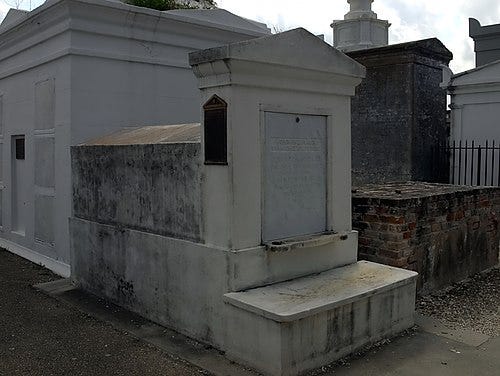
Tomb of Homer Plessy in New Orleans
On January 5, 2022, Louisiana Governor John Bel Edwards granted Plessy a posthumous pardon. The pardon was issued in accordance with “The Avery C. Alexander Act.” This 2006 act was passed by the Louisiana Legislature to expedite the pardon process for individuals who were criminalized and convicted under Louisiana laws created for the purpose of maintaining or enforcing racial separation or discrimination against individuals.
There are no known photographs of Homer Plessy. An internet search shows repeated erroneous entries of Homer Plessy using a picture of P.B.S. Pinchback, the second Black acting Lieutenant Governor and then Governor of Louisiana. The first Black man to hold both of those posts was Oscar Dunn.
In fact, the Plessy and Ferguson Foundation was so frustrated by the proliferation of misidentification that it has an item on its website entitled, “No, Internet, this is not Homer Plessy!”
Today In Black History
In 1493, Christopher Columbus’s second voyage to the Caribbean reached Puerto Rico, and Columbus oversaw the massacre and near genocide of the Taíno indigenous population that had lived there for millennia.
In 1863, President Abraham Lincoln delivered his famous “Gettysburg Address,” reminding people that the promises of the Declaration of Independence and Constitution had not yet been fulfilled.
In 1977, Robert Edward Chambliss, a former KKK member, was convicted of first-degree murder in connection with the 1963 bombing of the 16th Street Baptist Church in Birmingham, Alabama, that killed four Black little girls.
In 1993, Black and white leaders in South Africa approved the new democracy constitution that gave Blacks the vote and ended white supremacist minority rule.
