

Issue #910 Today In Black History, Monday, August 18, 2025
After the Civil War, during Reconstruction, many Southern states resisted these changes, clinging to old racial hierarchies and white supremacy.
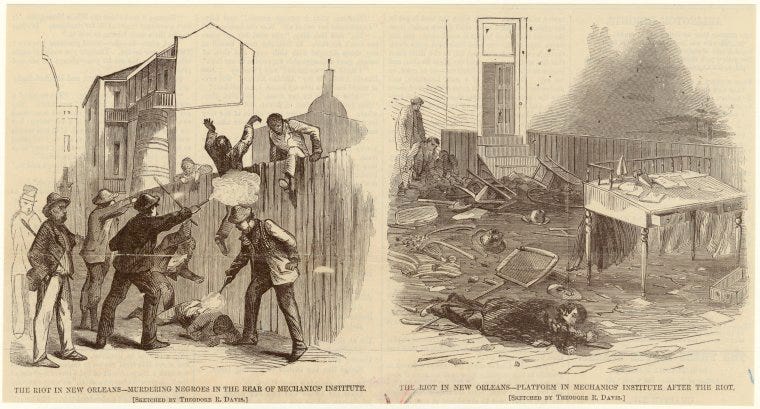
The New Orleans Massacre (also known as the New Orleans Riot) occurred on July 30, 1866, when white residents attacked Black marchers gathered outside the Mechanics Institute, where the reconvened Louisiana Constitutional Convention met in response to the state legislature enacting racist Black Codes and limiting non-white suffrage.
Freedmen and their allies were determined to secure their civil rights and sought to hold a constitutional convention to draft a new state constitution that would enfranchise Black men. This effort was met with fierce opposition from white supremacists and former Confederate loyalists who were intent on maintaining the status quo.
Two of New Orleans’ primary leaders—Mayor John T. Monroe, a Confederate sympathizer, and Sheriff Harry T. Hays, a former Confederate general—strongly opposed the new constitutional convention. After a political rally on July 27, Hays gathered a posse of white officers, mostly ex-Confederates, to disrupt the convention, which began at noon on July 30.
As the delegates filed into the building, a crowd of protesters gathered outside the Mechanics Institute. Meanwhile, about 200 unarmed Black people, mostly Union veterans, approached the building in a parade form to show support. As they approached the building, bystanders harassed the marchers, and isolated scuffles broke out.
A mob composed of ex-Confederates and local police descended upon the convention-goers. Armed assailants fired into the crowd, indiscriminately targeting Black men and their allies who were unarmed and defenseless. The violence resulted in the death of approximately 34 Blacks and three whites, while many others were injured.
This event was preceded by the Memphis massacre just a few months earlier.
General Philip Sheridan, reporting to the War Department, said that delegates and peaceful supporters got hit “with firearms, guns, and knives, in a manner so unnecessary and atrocious as to compel me to say that it was murder.”
“It was no riot,” Sheridan said. “It was an absolute massacre by the police … without the shadow of a necessity.”
The New Orleans Massacre strengthened the argument by Radical Republicans (a faction in the Republican Party) that President Johnson’s Reconstruction plan was insufficient and that greater protection of African Americans was needed.
The New Orleans Massacre drew the attention of Congress and the broader public to the urgent need for federal intervention in the South. Congress moved to pass more robust Reconstruction Acts, aimed at protecting the rights of the newly freed Black population and curbing the power of Southern states to resist federal mandates.
Today In Black History
In 1892, the Black newspaper, “Afro-American,” began publishing in Baltimore, Maryland.
In 1906, 167 Black soldiers were accused of raiding Brownsville, Texas, leading to President Theodore Roosevelt ordering dishonorable discharges for the entire group. In 1972, all the soldiers were cleared of wrongdoing, with 165 of the 167 cleared posthumously.
In 1920, the Pan-African flag of three horizontal stripes of red (blood), black (skin), and green (land) was officially adopted.
In 1963, James Meredith became the first Black graduate of the University of Mississippi.
In 1964, South Africa was banned from the Olympic Games because of its apartheid policies.
In 1976, Vice Admiral Samuel Lee Gravely, Jr. was made Commander of the U.S. Third Fleet.
In 1977, South African anti-apartheid activist Steve Biko was arrested at a roadblock and died from a police beating one month later.
In 2016, Jamaica’s Usain Bolt won the men’s 200-meter gold medal for the third successive Summer Olympics.
If you like us, REALLY like us, please click the little heart “Like” button at the top of this post!

Buttons:
Heart: Like Bubble: Comment Arrow Up: Share Arrows Circle: Restack
If you like us, REALLY like us, please click the “Like” button at the top of this post!
Your “Likes” mean a LOT to us! We appreciate your support!
Buy Pam a cup of Colombian Coffee!
Engage with us and our posts on Substack Notes, where we publish new content almost daily.
Our July 2025 subscriber goals are 400 new free subscribers and 80 new paid subscribers! You can help us reach our goal!
We Are Speaking is a reader-supported publication. To receive new posts and support our work, consider becoming a free or paid subscriber.
Follow Pam on Bluesky, the best “X” alternative.
Follow Keith on Bluesky, the best “X alternative.
Independent Authors and Creative Professionals: Check out my valuable books and courses on Branding and Marketing just for you via Pam Speaks 2 You.

