

Issue #956 Today In Black History, Monday, November 10, 2025
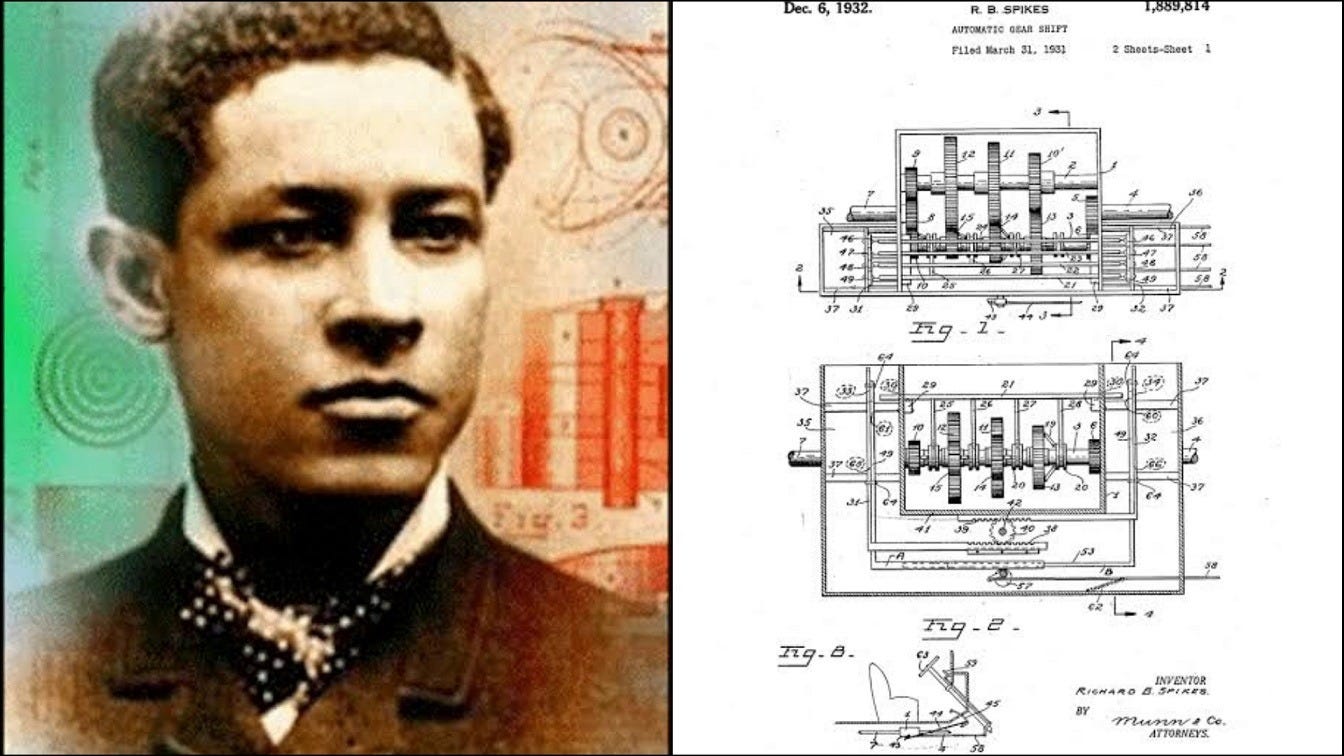
Richard Spikes was an African American inventor whose work spanned various industries, leaving an indelible mark on automotive technology, among others.
Richard Bowie Spikes was born on October 2, 1878, in San Francisco, California, into a musically inclined family. With limited formal education, Spikes developed his skills through practical experience and sheer perseverance.
Although a capable musician—piano and violin—Richard Spikes learned to cut hair in his father’s barber shop, and then became a public school teacher in Beaumont, Texas. On October 8, 1900, he married Lula Belle Charlton (1880–1970), the daughter of Charles Napoleon Charlton, an ex-slave who co-founded the city of Beaumont’s first public schools for African Americans. Richard and Lula had one son, Richard Don Quixote Spikes (1902–1989).
Spikes continued working as a barber, owning and operating shops in San Francisco, Fresno, California and Stockton, California until his eyesight began to fade due to the effects of glaucoma which affected other members of his family, including his brother John, who received a patent for a “writing aid for the blind”—a paper holder, essentially a pad with a clip affixed to it in order to secure sheets of writing paper.
Spikes has over a dozen patents to his name, including the beer tap, which he created while running a saloon.
His patent, awarded in 1908, was purchased by the Milwaukee Brewing Company and is still presently in use in establishments across the world.
Spikes later developed modifications to the automotive directional signals that drivers use today. He also created the automatic gear shift, the billiard cue rack, and automatic braking systems still used today by buses and schools.
Here are a few of his most notable contributions:
Automobile Turn Signal: Richard Spikes invented an early version of the automatic gearshift in 1932, a precursor to the modern automatic transmission. However, he is perhaps best known for his work on the turn signal, an essential component that has significantly improved driving safety.
Beer Keg Tap: Spikes invented an improved beer keg tap in 1910, which allowed bartenders to serve beer more efficiently and hygienically. This invention revolutionized the way beer was stored and served, setting a standard that is still in use today.
Transmission and Safety Improvements: Spikes continued to innovate in the automotive field, enhancing gear-shifting technologies. His work laid the groundwork for transmission systems and safety features that are now standard in vehicles worldwide.
Biscuit Cutter: Among his diverse inventions was a mechanical device for cutting dough into biscuit shapes, demonstrating his ability to improve processes across industries.
Richard Spikes’ work was often unrecognized during his lifetime, a plight common to many African American inventors of his era.
Richard Spikes died in Los Angeles, California, on January 22, 1963 (aged 84).
Today In Black History
In 1780, the African Union Society of Newport, Rhode Island, was founded as the first Black mutual aid society.
In 1891, Black inventor Granville T. Woods patented the electric railway.
In 1898, Samuel W. Rutherford founded the National Benefit Life Insurance Company, the largest Black insurance company for several years.
In 1898, the Wilmington (North Carolina) Massacre occurred, when white supremacists violently overthrew all of the Black and white elected officials, and 22 Blacks were killed, and thousands of Blacks fled in the night and never returned.
In 1957, golfer Charlie Sifford won the Long Beach Open and became the first Black person to win a major golf tournament.
In 1960, President-elect John F. Kennedy named Andrew T. Hatcher as the first Black associate presidential press secretary.
In 1975, one of the largest freighters on the Great Lakes, the Edmund Fitzgerald, sank in Lake Superior, with the loss of the entire crew of 29 men, due to extremely high winds. It was later found in two large pieces by U.S. Navy aircraft.
