

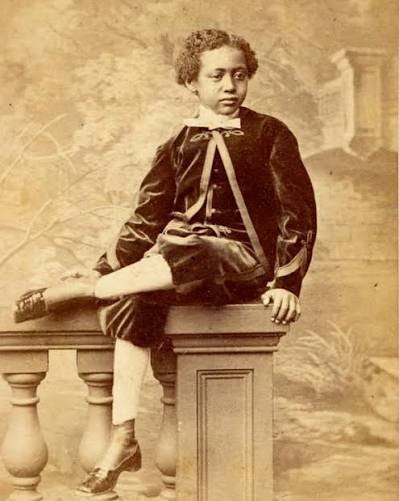
This is an artist’s rendition of Robert Hemmings, based on his known bi-racial heritage and position with Thomas Jefferson.
Issue #1050 Today In Black History Monday, July 13, 2026
Please scroll to the end of this post to support us by subscribing at the free or paid level.
Independent authors and creative professionals! Please scroll to the “Shameless Plug” at the end to find out about the Pam Speaks 2 You Creative Business app for creative branding and marketing.
In the summer of 1776, while Thomas Jefferson sat in a rented room in Philadelphia drafting the words “all men are created equal,” a 14-year-old enslaved boy named Robert Hemmings was down the hall, tending to Jefferson’s clothes, his horses, and his grooming. Hemmings had no vote in the document being written just feet away, and no freedom of his own. Robert Hemings (sometimes spelled Hemmings) was the older brother of Sally Hemings. They shared the same mother, the enslaved matriarch Elizabeth (Betty) Hemings, and both were fathered by the wealthy planter John Wayles, who was also the father of Thomas Jefferson’s wife, Martha.
Robert and Sally Hemmings were half-siblings to Thomas Jefferson’s wife, Martha Hemmings Jefferson.
Robert Hemmings was born in 1762, the first of six children born to Elizabeth Hemings and John Wayles, the father of Jefferson’s wife, Martha. When Wayles died in 1773, Elizabeth Hemings and her children were brought to Monticello, and eleven-year-old Robert joined the plantation’s enslaved domestic staff. By age thirteen, he had become Jefferson’s personal bodyservant — a role that meant he was on call around the clock to shave, dress, and groom his enslaver, and to accompany him virtually everywhere.
When Jefferson traveled to Philadelphia in 1775 and 1776 as a delegate to the Second Continental Congress, Hemmings made the trip both years, present in the city while the document that would define American liberty was being written by a man who held him in bondage. For nearly a decade after, Hemmings continued in Jefferson’s service, traveling with him until Jefferson departed for France in 1784.
What set Hemmings apart was what came next. He married Dolly, an enslaved woman living near Fredericksburg and later Richmond, and the couple had two children. Rather than remain tethered to Monticello, Hemmings kept finding ways to work independently in Virginia, closer to his family, even as Jefferson kept summoning him back.
In 1794, a French émigré physician, Dr. George Frederick Stras, agreed to advance the cost of Hemmings’s freedom, with Hemmings repaying the debt through his own labor. Jefferson, by his own letters, was reluctant and felt he’d been undercompensated — but he signed the deed of manumission at Monticello on December 24, 1794. Robert Hemmings became the first person Thomas Jefferson ever legally freed.
He settled in Richmond, appeared in tax rolls by 1799, and seems to have run a livery or hauling business from a half-acre lot he owned downtown. He lost a hand in an accident later in life and died in 1819, having lived twenty-five years as a free man — a fact often lost in the shadow of his more famous relatives, including his younger sister Sally Hemings.
Today In Black History
In 1787, the Continental Congress adopted the Ordinance of 1787 (the Northwest Ordinance), which established the first organized US territory and set requirements for statehood by guaranteeing equal status with the original 13 states, outlawing slavery, and protecting civil liberties.
In 1863, the New York Draft Riots occurred, spurred by hostility toward the draft and the fear of Blacks. White mobs swept through the streets, murdering over 100 Blacks and hanging them on lamp posts. Working-class Irish immigrants also burned a provost marshal’s office and the Colored Orphan Asylum.
In 1868, the Alabama legislature met in Montgomery, with 26 Black members and 206 white members.
In 1868, Oscar J. Dunn, a former slave, was formally installed as Lieutenant Governor in Louisiana, the highest elected office held to date by an African American.
In 1919, race riots in Longview and Gregg counties in Texas were part of the twenty-six riots during the Red Summer of 1919.
In 1934, Akinwande OluwoleSoyinka, a Nigerian playwright and political activist, won the Nobel Prize for Literature.
In 1940, Black inventor Frederick McKinley Jones patented a Shock-Proof Refrigeration Device that enabled the transportation of food without using ice to keep it cool.
In 1965, Thurgood Marshall was appointed as the first Black Solicitor General, tasked with arguing cases for the U.S. government before the Supreme Court.
In 1972, Shirley Chisholm became the first African American presidential nominee, with 151 votes from the Democratic delegates polled.
In 1975, the African nation of São Tomé and Príncipe gained its independence from Portugal.
In 1976, Congresswoman Barbara Jordan (D-TX) became the first person to give the keynote address at a national political convention, speaking at the Democratic National Convention.
You can always leave any questions in the comments or email us.
Please consider becoming a paid subscriber for $10/month or less to access all of the articles and other benefits.


If you are an independent author or creative professional, this is your chance to join the Pam Speaks 2 You Creative Business Community, and there’s an app for that!
The Pam Speaks 2 You Apple/iOS app is live!
The Pam Speaks 2 You Google/Android app is live!
You can also access the Pam Speaks 2 You app on the web!