Issue #1,097 Today In Black History, Friday, November 6, 2026
Please enter your email below to support us by subscribing at the free or paid level for less than $10/month.
We Are Speaking is a small reader-supported publication. To receive new posts and support our work, consider subscribing at the free or paid level.
Independent authors and creative professionals! Please scroll to the “Shameless Plug” at the end to find out about the Pam Speaks 2 You Creative Business Community app for creative branding and marketing.
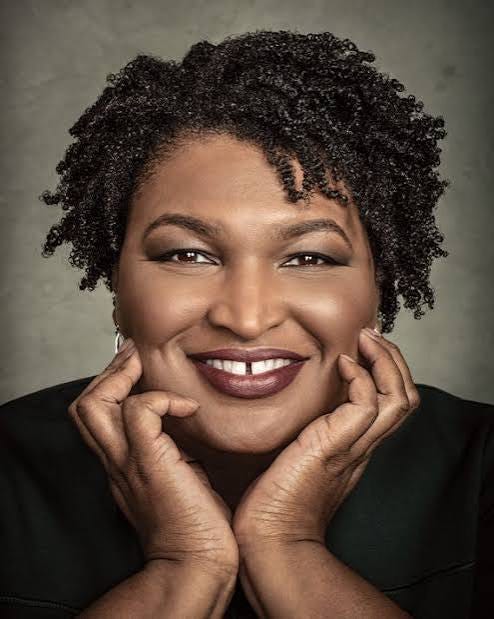
Some leaders win offices. Others change the map so that many more people can win. Stacey Abrams is the second kind. Her legacy in American politics comes less from any title she held than from the millions of Georgians she helped bring to the ballot box.
Stacey Yvonne Abrams was born on December 9, 1973, in Madison, Wisconsin, and grew up in Gulfport, Mississippi, as one of six children.
Her parents were working-class and deeply committed to service, and both later became United Methodist ministers. They taught their children three rules: go to church, go to school, and take care of each other. When the family moved to Atlanta, the young Abrams found the city that would shape her life’s work.
She was valedictorian of her high school. Then she earned a degree from Spelman College, a master’s in public affairs from the University of Texas, and a law degree from Yale. She worked as a tax attorney and then served as Atlanta’s deputy city attorney. In 2006, she won a seat in the Georgia House of Representatives.
She later became a Democratic leader in the state legislature and a nationally known voting-rights advocate. As House Minority Leader from 2011 to 2017, she was the first woman to lead either party in the Georgia General Assembly. She was also the first African American to lead in the House.
Her most lasting work happened outside the Capitol. In 2013, she founded the New Georgia Project, a voter registration drive aimed at the hundreds of thousands of eligible Georgians who weren’t registered. Most of them were young people and people of color. The method was patient, door-to-door organizing. Volunteers met people where they lived, at churches, barbershops, college campuses, and community events, and treated every unregistered citizen as a voter waiting to be counted.
In 2018, Abrams became the first Black woman in American history to win a major party’s nomination for governor. She narrowly lost to Republican Brian Kemp. The race featured disputes over purged voter rolls, closed polling places, and long lines. Rather than step away, she founded Fair Fight Action to fight voter suppression and protect access to the ballot across Georgia and the nation.
The payoff came in 2020. Georgia voted for a Democratic presidential candidate for the first time since 1992. Two months later, runoff elections sent Raphael Warnock, Georgia’s first Black senator, and Jon Ossoff to Washington. Leaders across the state credited the groundwork she had laid.
In 2022, Atlanta Mayor Andre Dickens asked a crowd of supporters, “You know why Georgia turned blue in 2020? Because of the hard work of Stacey Abrams.” Her organizing model, built on registering new voters year-round rather than only at election time, has since been studied and copied by organizers in other states.
Abrams ran for governor again in 2022 and lost her rematch with Kemp by nearly eight points. In January 2026, she ruled out a third run for governor, while pledging to keep fighting for Georgia voters and voters across America.
She is also a prolific author. Under the pen name Selena Montgomery, she wrote romantic suspense novels. Under her own name, she wrote the bestselling legal thrillers While Justice Sleeps and Rogue Justice, the memoir Lead from the Outside, Our Time Is Now on voting rights, and books for children. In 2021, she was nominated for the Nobel Peace Prize for her work to protect democracy.
Stacey Abrams’s story shows that power isn’t only won on election night. It’s built over years, one conversation, one registration card, and one neighbor at a time. Every Georgian who cast a ballot for the first time because someone knocked on their door is part of her legacy.
Her contributions to public service, voting rights advocacy, literature, and media have earned her wide acclaim and formal honors:
In 2012, the John F. Kennedy Library honored her leadership with the John F. Kennedy New Frontier Award.
The Georgia AFL-CIO recognized her commitment to working families by presenting her with the Friend of Labor Award.
Her alma mater celebrated her achievements on April 17, 2019, when Yale Law School presented her with the Yale Law Women Alumni Achievement Award.
She repeatedly earned NAACP Image Awards in 2021, 2022, and 2023, including the prestigious Mildred Bond Roxborough Social Justice Impact Award alongside literary distinctions.
Her media work earned national attention, including Primetime Emmy Award nominations for the documentary All In: The Fight for Democracy and a 2021 nomination for Outstanding Character Voice-Over Performance.
Her legal acumen was further recognized when she received the Stevens Award for Outstanding Legal Contributions.
You can follow Stacey on her Substack, “Assembly Notes,” by clicking here.
Today In Black History
In 1920, James Weldon Johnson became the NAACP’s first Black Executive Secretary.
In 1928, Oscar DePriest was elected to the 71st Congress from Illinois’ First Congressional District in Chicago, becoming the first Black Congressman from the North and the first Black in Congress since 1901.
In 1962, Otis M. Smith was elected to a full term on Michigan's Supreme Court.
In 1962, Augustus “Gus” F. Hawkins (D-CA) became the first elected Black Congressman from the West.
In 1973, Michigan State Senator was elected the first Black mayor of Detroit.
In 1976, Vernon E. Jordan, Jr., former Executive Director of the United Negro College Fund and the National Urban League, was appointed head of President-elect Bill Clinton’s transition team.
In 2008, President-elect Barack Obama named Emanuel Chief of Staff.
Paid subscribers can always leave questions in the comments or email us.
Please consider becoming a paid subscriber for $10/month or less to access all of the articles and other benefits.
If you are an independent author or creative professional, this is your chance to join the Pam Speaks 2 You Creative Business Community, and there’s an app for that! We have 5 eBooks and 5 courses, plus networking communities designed specifically for you in the Branding and Marketing Academy!