Issue #1,099 Today In Black History, Wednesday, November 10, 2026
Please enter your email below to support us by subscribing at the free or paid level for less than $10/month.
We Are Speaking is a small reader-supported publication. To receive new posts and support our work, consider subscribing at the free or paid level.
Independent authors and creative professionals! Please scroll to the “Shameless Plug” at the end to find out about the Pam Speaks 2 You Creative Business Community app for creative branding and marketing.
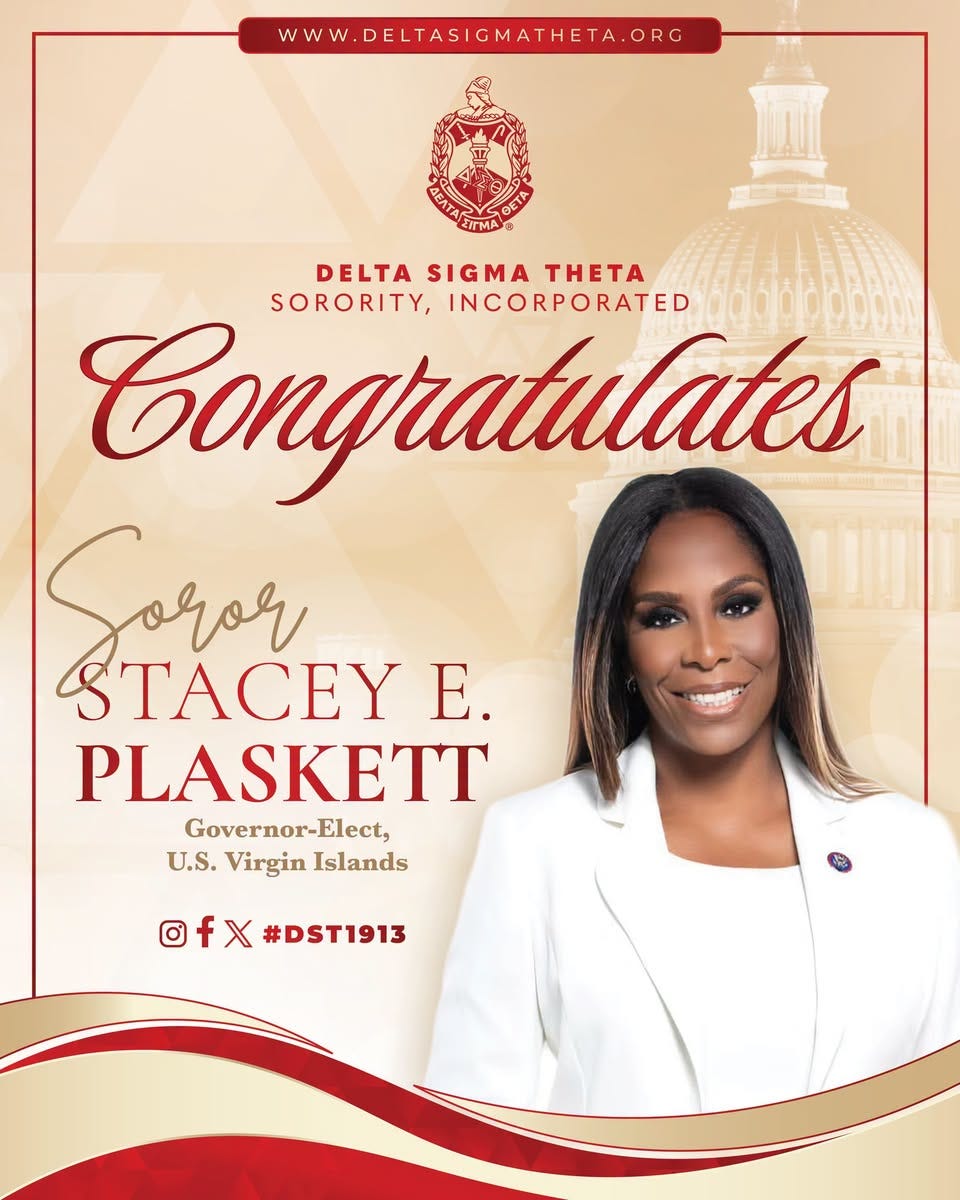
Stacey Plaskett’s career has unfolded across geography, law, and the boundaries of American political representation. A Democrat representing the U.S. Virgin Islands in the House of Representatives, she has become one of the territory’s most visible advocates in Congress—and a prominent national figure through her work on investigations and oversight.
Born in New York City in 1966, Plaskett grew up in Brooklyn in a family with roots in the U.S. Virgin Islands. She attended the Brooklyn Friends School and earned a bachelor’s degree from Georgetown University. She later received her law degree from American University’s Washington College of Law. That education led to a career in public service and law, including work as a prosecutor in the Bronx and as counsel in the U.S. Department of Justice’s tax division. She also served in government in the U.S. Virgin Islands, building experience on both the mainland and in the territory she would eventually represent.
Governor-elect Plaskett is my Soror in Delta Sigma Theta Sorority.
In 2014, Plaskett was elected as the Virgin Islands’ delegate to the U.S. House. The territory’s delegate can participate in debate and serve on committees but does not vote on final passage of legislation on the House floor. That distinction is central to her role: she represents constituents in the federal process while confronting the limits placed on the political voice of U.S. territories. Virgin Islanders are U.S. citizens, yet they cannot vote for president while residing in the territory and lack voting representation in Congress. Plaskett has used her position to press for greater attention to those democratic disparities.
Her congressional work has focused on issues with direct consequences for island life, including disaster recovery, health care, economic development, and the relationship between the federal government and the territories. The devastation caused by hurricanes Irma and Maria in 2017 made recovery and resilience urgent priorities. Plaskett has pressed for federal resources and long-term investment, while arguing that the territory’s needs should not disappear from national attention once the immediate crisis fades. Her advocacy also reflects a broader challenge: island communities face particular exposure to hurricanes, infrastructure strain, and the effects of climate change, even as they often have less political power over federal policy.
Plaskett gained national prominence as a member of the House Select Committee investigating the January 6, 2021 attack on the U.S. Capitol. During public hearings, she questioned witnesses and presented evidence about efforts to overturn the 2020 election. Her prosecutorial background and controlled, detail-driven questioning helped make her a conspicuous voice in the committee’s work. The role also broadened public awareness of the Virgin Islands’ delegate, demonstrating that a representative without a final floor vote can still shape national debate and congressional investigations.
Her influence is not without political disagreement. Plaskett’s positions and high-profile committee work have drawn criticism from opponents, while supporters see her as an effective advocate for both her constituents and democratic accountability. The constraints of territorial representation remain larger than any one officeholder: a delegate can amplify concerns, negotiate, and participate in committee work, but cannot cast the decisive vote available to members from states.
That tension gives Plaskett’s career a significance beyond a list of offices. She has worked within institutions that offer her constituents an incomplete voice, while using the authority she does have to make their concerns harder to ignore. Her path—from Brooklyn, through law and government service, to Congress—also complicates familiar assumptions about who gets to shape national politics. For the U.S. Virgin Islands, her work is measured not only in legislation or hearings, but in visibility: whether islanders are treated as participants in the country’s public life rather than an afterthought. Plaskett’s career shows both the reach of determined representation and the limits that representation still has to confront.
Today In Black History
In 1831, Nat Turner, a revolutionary freedom fighter and leader of a slave revolt in Southampton County, VA, was hanged in Jerusalem, VA, for his involvement in the revolt.
In 1890, Black inventor D. McCree patented the Portable Fire Escape.
In 1901, a new constitution with a “grandfather clause,” designed to eliminate Black voters by allowing only voters whose grandfather could vote, was adopted in Alabama.
In 1969, Black inventor George R. Carruthers patented an Image Converter for detecting electromagnetic radiation.
In 1975, the Republic of Angola proclaimed its independence from Portugal.
In 1984, Rev. Martin Luther King, Sr., a civil rights leader and the father of Dr. Martin Luther King, Jr., died.
Paid subscribers can always leave questions in the comments or email us.
Please consider becoming a paid subscriber for $10/month or less to access all of the articles and other benefits.
If you are an independent author or creative professional, this is your chance to join the Pam Speaks 2 You Creative Business Community, and there’s an app for that! We have 5 eBooks and 5 courses, plus networking communities designed specifically for you in the Branding and Marketing Academy!