

Issue #1,042 Today In Black History, Wednesday, June 24, 2026
June is Black Music Appreciation Month. Black Music Month was initiated in 1979 by Philadelphia songwriter Kenny Gamble, pioneering radio DJ Ed Wright, and media strategist Dyana Williams. These three music icons successfully campaigned the idea to President Jimmy Carter, who held the first White House reception celebrating Black music on June 7, 1979.
This month in Today In Black History, we will highlight a few of the famous and lesser-known Black musicians.
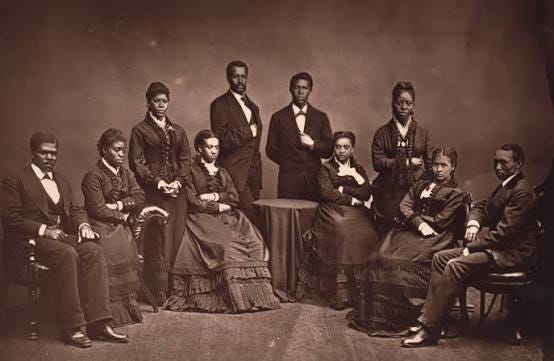
There’s a moment in 1871 that changed American music forever. A small, exhausted group of young Black singers boarded a train in Nashville, Tennessee, with almost nothing to their name — no guarantee of success, no warm reception waiting for them, and certainly no idea that their voices would one day echo in the concert halls of Europe and the corridors of the White House. They were the Fisk Jubilee Singers, and what they carried with them was priceless: the sacred songs of their enslaved ancestors.
The Fisk Jubilee Singers were founded in 1871 under the direction of George Leonard White, the treasurer and music teacher at Fisk University in Nashville. The school, established in 1866 to educate formerly enslaved people, was in desperate financial trouble. Desperate to keep Fisk’s doors open, White assembled eleven students and set out on a concert tour of the Northern United States. The name “Jubilee” was a nod to the biblical Year of Jubilee — a time of liberation and freedom.
The early tour was rough. Audiences were sometimes hostile, and hotels regularly turned them away. But when the singers performed, something remarkable happened. Crowds who expected novelty were moved to tears instead. The songs the Jubilee Singers shared — “Swing Low, Sweet Chariot,” “Go Down, Moses,” “Steal Away,” “Nobody Knows the Trouble I’ve Seen” — were Negro spirituals, the deeply felt, often coded songs created by enslaved Black Americans. These weren’t folk curiosities. They were testimonies.
The tour slowly caught fire. The group raised enough money to save Fisk University — and then they didn’t stop. In 1872, they performed at the World Peace Jubilee in Boston before an audience of 40,000 people. President Ulysses S. Grant received them at the White House. Newspapers that had once ignored them now celebrated them.
Their international tour, beginning in 1873, was nothing short of historic. In Britain, they performed for Queen Victoria, who was so moved she commissioned a portrait of the group. They toured Germany, where composer Antonín Dvořák later credited their spirituals as a major influence on his landmark New World Symphony. They sang for heads of state, packed concert halls, and returned home with over $150,000 — an enormous sum that funded the construction of Jubilee Hall at Fisk, the first permanent building in the American South built expressly to educate Black students. That building still stands today.
The Fisk Jubilee Singers did something no institution could have planned: they took music that was in danger of fading from memory and placed it at the center of American cultural life. Before their tours, Negro spirituals were often dismissed or overlooked. The Jubilee Singers treated them as the masterworks they were — performing them with full artistic seriousness on the world’s most prestigious stages. In doing so, they forced the world to listen.
Their influence rippled outward into virtually every corner of American music. Gospel, blues, jazz, and soul all draw from the well of the spiritual tradition the Jubilee Singers championed. Artists from Mahalia Jackson to Beyoncé carry forward a legacy that runs directly through those eleven students who boarded a train in 1871.
The Fisk Jubilee Singers never stopped. The ensemble has continued performing without interruption for over 150 years, making it one of the longest-running musical groups in American history. In 2008, they were awarded the National Medal of Arts by President George W. Bush. In 2022, a collection of their early recordings from 1909 was added to the Grammy Hall of Fame.
Their story is one of survival, artistry, and profound dignity. They sang when the world tried to silence them — and the world, eventually, couldn’t help but listen.
Today In Black History
In 1884, John R. Lynch, a former congressman from Mississippi, was elected temporary chairman of the Republican convention and became the first Black person to preside over the deliberations of a national political party.
In 1885, Samuel David Ferguson, a consecrated bishop of the Protestant Episcopal Church, was named bishop of Liberia, becoming the first Black American with full membership in the House of Bishops.
In 1896, Booker T. Washington, the founder of Tuskegee Institute, received an honorary degree from Harvard University.
In 1937, Mary McLeod Bethune, an educator and civil rights leader, became the first woman to receive a major federal appointment when she was named Director of Negro Affairs of the National Youth Administration.
In 1960, Patrice Lumumba became the first Prime Minister of the independent nation of Congo.
In 1971, Daniels and Bell of New York became the first Black-owned securities firm admitted to the New York Stock Exchange.
In 1972, the Democratic National Convention approved the nomination of Yvonne Braithwaite Burke as co-chairperson.
In 1988, Atlanta University and Clark College, two of the nation’s oldest HBCUs, merged to create Clark Atlanta University.
Please share and subscribe to help us grow this publication.
If you like us, REALLY like us, please click the “Like” button at the end of this post!
We appreciate your support!
You are welcome to view “We Are Speaking” in Substack Notes. You can also read other Substack publications without subscribing to them when you join Notes.
To financially support “We Are Speaking” for no more than $5 per month, please subscribe at the paid level.
