

Issue #1063 Today In Black History Monday, August 13, 2026

As a small Substack publication, we could really use your support!
Please scroll to the end of this post to support us by subscribing at the free or paid level for less than $10/month.
Independent authors and creative professionals! Please scroll to the “Shameless Plug” at the end to find out about the Pam Speaks 2 You Creative Business Community app for creative branding and marketing.
As we now know, the current occupant of the White House is working hard to erase any American history that is not white history, and is also encouraging museums to downplay or eliminate Black history.
Two of the country’s most important repositories of Black history exist because people in power kept saying no — and Black communities kept building anyway. The Schomburg Center for Research in Black Culture and the Smithsonian’s National Museum of African American History and Culture (NMAAHC) were born nearly a century apart, out of very different circumstances, but they share the same origin story at heart: a refusal to let Black history go undocumented, uncollected, and unclaimed.
A Collector’s Insistence
The Schomburg Center traces back to one man’s personal library. Arturo Alfonso Schomburg, an Afro-Puerto Rican bibliophile living in Harlem, spent decades amassing books, manuscripts, art, and artifacts documenting the African diaspora, driven partly by a teacher who once told him Black people had no history worth studying. By the 1920s, requests for materials “by and about Negroes” at the New York Public Library’s 135th Street Branch had grown so heavy that the library established the Division of Negro Literature, History and Prints on May 8, 1925. A year later, the Carnegie Corporation paid $10,000 for Schomburg’s roughly 5,000-item collection and donated it to the library, on the condition that it stay in Harlem. Schomburg himself became the division’s curator in 1932. The center moved into a dedicated building at 515 Malcolm X Boulevard in 1980, and both that building and the original branch were named National Historic Landmarks in 2016.
From Research Hub to Cultural Institution
The Schomburg Center quickly became the intellectual backbone of the Harlem Renaissance and every major movement in Black scholarship and activism that followed, from the New Negro movement through the Black Power era. Today it operates as one of the New York Public Library’s four research libraries, organized into five divisions covering art and artifacts, general research, manuscripts and rare books, moving image and recorded sound, and photographs and prints. Scholars, filmmakers, genealogists, and students use its holdings to trace enslaved ancestors, verify civil rights history, and mine primary sources unavailable anywhere else. It also hosts public programming — author talks, exhibitions, and the annual Black Comic Book Festival — that keeps it a living cultural hub, not just an archive.
An Unlikely Namesake
Before there could be an NMAAHC, there had to be a Smithsonian, and its name comes from a man who never set foot in the country where he eventually had a museum funded by his family. James Smithson was a British chemist and mineralogist, born in France in 1765 to an illegitimate line that barred him from inheriting his father’s name and title. When he died in 1829, his will left his fortune to a nephew, with an unusual condition: if the nephew died without heirs, the money would go “to the United States of America, to found at Washington, under the name of the Smithsonian Institution, an establishment for the increase and diffusion of knowledge among men.” The nephew died childless in 1835, and Congress accepted the bequest — more than $500,000 in gold coin at the time — the following year. President James K. Polk signed the act creating the Smithsonian Institution on August 10, 1846. Smithson’s exact motives are still debated, but the institution built in his name eventually grew to encompass 19 museums, including, 170 years later, one built specifically to tell the story he never lived to see.
A Century-Long Fight for a National Museum
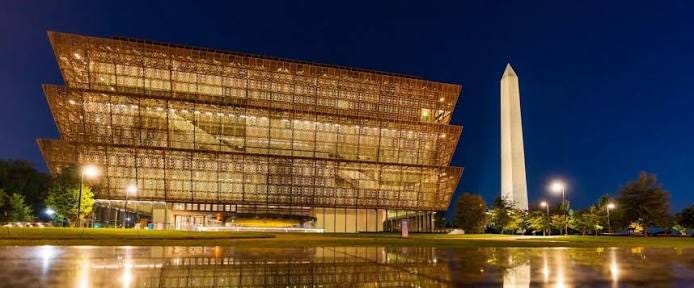
The push for a national museum started even earlier, in 1915, when Black Civil War veterans gathered in Washington, D.C., to mark the war’s 50th anniversary and proposed a memorial to Black military service. Congress authorized it in 1929, but the Great Depression killed its funding. The idea resurfaced periodically for decades until Representative John Lewis took it up in 1987, introducing legislation nearly every year for fifteen years despite repeated defeat, including a 1994 blockade by Senator Jesse Helms. President George W. Bush finally signed authorizing legislation in 2003, and the National Museum of African American History and Culture opened on the National Mall on September 24, 2016, as the Smithsonian’s 19th museum.
A Landmark Still Doing Its Work
Designed by architect David Adjaye with a bronze latticework “corona” inspired by Yoruban art, the NMAAHC now holds more than 45,000 artifacts spanning slavery, Reconstruction, the civil rights movement, and contemporary Black culture, and draws visitors from around the world alongside nearly 300,000 members supporting its work. Between them, the Schomburg Center and the NMAAHC represent two answers to the same historic demand — one built from a single collector’s insistence that his people’s story mattered, the other from a century of organized political will. Both now stand as proof that the fight to preserve Black history was never just about the past; it was about making sure the future had somewhere to look it up.
Today In Black History
In 1897, Black inventor W.B. Purvis patented the electric railway switch.
In 1960, the African nation of Gabon gained its independence from France.
In 1984, Roberto Clemente, born in Puerto Rico and of Black and Hispanic heritage, became the second baseball player to be featured on a stamp.
Paid subscribers can always leave questions in the comments or email us.
Please consider becoming a paid subscriber for $10/month or less to access all of the articles and other benefits.

If you are an independent author or creative professional, this is your chance to join the Pam Speaks 2 You Creative Business Community, and there’s an app for that!
The Pam Speaks 2 You Apple/iOS app is live!
The Pam Speaks 2 You Google/Android app is live!
You can also access the Pam Speaks 2 You app on the web!