

Issue #1047 Today In Black History July 6, 2026
Parts of this article were written in 2023.
Independent authors and creative professionals! Please scroll to the “Shameless Plug” at the end to find out about the Pam Speaks 2 You Creative Business app for creative branding and marketing.
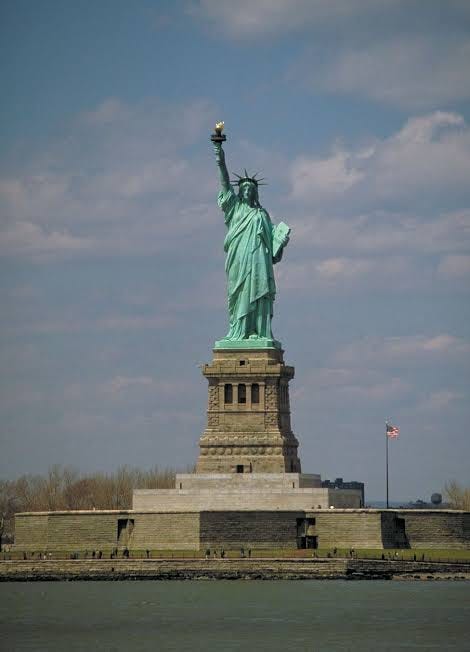
When Lady Liberty was dedicated in New York Harbor in 1886, most Americans saw her as a symbol of democracy and Franco-American friendship. Fewer knew the statue’s origins were rooted in the abolition of slavery.
The idea began in 1865, just months after the Civil War ended, when French political thinker Édouard de Laboulaye gathered a group of fellow abolitionists in Versailles. Laboulaye was no casual observer of American affairs — he was a U.S. Constitution scholar, a firm supporter of Abraham Lincoln, and cofounder and president of the French Anti-Slavery Society, founded that same year to push for abolition worldwide and raise money for newly freed people in the United States.
Laboulaye proposed a monumental gift to the United States to honor two achievements at once: the Union’s victory in the Civil War and the abolition of slavery. He hoped the tribute would also inspire the French people, then living under a repressive monarchy, to demand their own democratic freedoms.
Sculptor Frédéric Auguste Bartholdi ran with the idea, and early designs had Liberty holding broken chains in her hand. American financiers backing the project balked, wary of a monument that spoke too directly to slavery. The chains were moved out of her raised hand and down to her feet, where they remain today — a broken shackle at her right foot, the chain reappearing at her left, its final link snapped. It’s a detail almost no visitor notices, since it’s hidden beneath her robes at most viewing angles.
Even so, the symbolism didn’t erase reality. The Black press was quick to point out the gap between the statue’s promise and Black Americans’ lived experience. Racism and disenfranchisement didn’t end with the Civil War, and W.E.B. Du Bois later wrote that he felt none of the hope in Liberty’s torch that immigrant arrivals described — freedom she represented was not yet freedom for him or his race.
The Statue of Liberty’s foundation story is a reminder that monuments carry more history than their postcards suggest — and that the fight the statue’s own broken chains gestured toward was, in 1886, still very much unfinished.
Immigration is once again a very hot topic in the United States, with heavy negative promotion by Donald Trump and Stephen Miller.
Just before every election, the Republicans claim that "caravans of immigrants" are illegally invading America from the southern border. One of Trump’s first acts as president was to institute a “Muslim ban,” no matter the country of origin.
They're coming here to take your jobs, rob your homes, flood your communities with drugs, replace your white, Christian society with socialism, communism, and Islam, and eventually become Democratic voters. And...they're BROWN and don’t speak English!
After the recent end of the Trump era, the "Title 42" act that limited immigration at the southern border, supposedly due to concerns about the spread of Covid-19, the Republicans announced that there would be a huge surge of immigrants trying to enter the country. However, just the opposite happened: the number of people trying to enter the U.S. through Mexico, for example, actually went down.
In the mid-to-late 1800s, immigrants from many European countries fled to America, primarily to flee from hunger and political strife. Every new wave of immigrants was met with derision and discrimination.
Just as today, most immigrants worked the worst jobs or started their own businesses, often living in the worst housing situations while employing everyone in their families.
The reason policemen are often depicted as stereotypical Irishmen is that, during the 19th century, being a policeman on the East Coast (particularly in Boston and New York) was a low-level and dishonorable profession, and only Irishmen were hired as police officers.
Throughout American history, various laws have been passed to restrict or eliminate immigration, particularly from certain countries and regions. One of the most notable examples is the Chinese Exclusion Act of 1882, which prohibited Chinese laborers from entering the United States for 10 years and prevented Chinese immigrants from becoming citizens.
Other laws, such as the Immigration Act of 1924, established national-origin quotas to restrict immigration from Southern and Eastern Europe.
In 1952, the Walter–McCarran Act finally nullified all federal anti-Asian exclusion laws and allowed for the naturalization of all Asians.
Other immigration quotas still remained in place.
Finally, the Immigration and Nationality Act of 1965 (also known as the Hart-Celler Act) abolished the national origins quota system that had been in place since 1924. The new law focused on immigrants' skills and family relationships with U.S. citizens or residents rather than on their country of origin.
The act was a response to changing social attitudes and the civil rights movement, which challenged past discriminatory policies.
The 1965 law opened the doors to millions of immigrants from Asia, Africa, the Middle East, and Latin America, and helped shape modern-day America into a more diverse and multicultural society.
And a more diverse and multicultural society is exactly what white nationalists in America are so afraid of.
In the mid-1800s, new waves of immigration began as Europe experienced economic and political upheaval. Millions of people from Ireland, Germany, Italy, and other countries came to America in search of a better life. They faced discrimination and prejudice from those who believed that they were taking jobs away from American-born citizens.
However, several generations later, many of the descendants of those immigrants are now fighting against the immigration of people who are coming here for the same reasons but from different countries than their ancestors.
In 1886, the Statue of Liberty was unveiled on Liberty Island in New York Harbor. The statue, a gift from France to America, quickly became a symbol of freedom and opportunity for immigrants. The statue's inscription, "Give me your tired, your poor, your huddled masses yearning to breathe free," became a rallying cry for those seeking a better life in America.
However, women, Blacks, and other non-whites were excluded from participating in the unveiling ceremony.
The poem on the Statue of Liberty, titled "The New Colossus," was written by Emma Lazarus (1849 - 1887) in 1883. The poem was not originally part of the statue, but it was added in 1903 as a tribute to Lazarus and her work on behalf of immigrants. The poem speaks to the idea of America as a nation of immigrants and a beacon of hope for those seeking a better life.
As a wealthy socialist, feminist, pro-refugee, and pluralist Jew, Emma Lazarus was exactly the kind of person today's Republicans rail against.
The New Colossus
Not like the brazen giant of Greek fame,
With conquering limbs astride from land to land;
Here at our sea-washed, sunset gates shall stand
A mighty woman with a torch, whose flame
Is the imprisoned lightning, and her name
Mother of Exiles. From her beacon-hand
Glows worldwide welcome; her mild eyes command
The air-bridged harbor that twin cities frame.
"Keep, ancient lands, your storied pomp!" cries she
With silent lips. "Give me your tired, your poor,
Your huddled masses yearning to breathe free,
The wretched refuse of your teeming shore.
Send these, the homeless, tempest-tost to me,
I lift my lamp beside the golden door!"
Back in the 1980s, the 40th American President, Republican Ronald Reagan, had quite a different take on immigration. He emphasized that the United States is a nation of immigrants and that its strength comes from its capacity to welcome those from other lands.
He also acknowledged the need for an immigration policy that was both effective and orderly, yet reflected America's checkered tradition of accepting foreigners, and proposed eight principles for such a policy.
Reagan desired that America's immigration policy should include the need for legal authority to control immigration, recognize the benefits of Mexicans obtaining employment in the United States, and employ a fair distribution of the impacts of the national immigration policy.
Reagan emphasized the need for international cooperation to help reduce the motivations for illegal immigration.
Most importantly, Reagan expressed his belief in the idea of amnesty for those who have put down roots and lived in the US, even though they may have entered illegally, like today's "Dreamers" who were brought here at a very young age by their parents.
Ronald Reagan would most likely not be welcome in today's Republican Party.
Today, immigration remains a contentious issue in American politics. Conservatives argue that ("Brown" and “Black”) immigrants take jobs away from American-born citizens, contribute to crime and other social problems, and contribute to the Great (White) Replacement Theory.
Liberals believe that all immigrants bring vitality and diversity to the country and that America's strength lies in its ability to welcome newcomers from around the world.
Today In Black History
In 1853, William Wells Brown published Clotel, the first novel by a Black American.
In 1868, the South Carolina General Assembly met with a Black majority, becoming the first time an American legislature had a Black majority.
In 1898, the U.S. Senate agreed to annex Hawai’i.
In 1957, Althea Gibson became the first Black woman tennis champion with her win in the women’s singles championship at Wimbledon.
In 1964, the African nation of Malawi gained its independence from Britain.
In 1967, the Nigerian Civil War erupted after Nigerian forces invaded the secessionist state of Biafra.
In 1975, the African nation of Comoros gained its independence from France.
In 1990, 4-time Olympic Gold Medal winner was commemorated on a U.S. postage stamp.
In 2016, African American man Alton Sterling was filmed while being shot to death by Baton Rouge, LA, police while being restrained on the ground.
In 2016, African American man Philando Castile was filmed while being shot to death by police in St. Paul, MN, after being pulled over for a broken rear light.
You can always leave any questions in the comments or email us.
Please consider becoming a paid subscriber for $5/month or less to access all of the articles and other benefits.


If you are an independent author or creative professional, this is your chance to join the Pam Speaks 2 You Creative Business Community, and there’s an app for that!
The Pam Speaks 2 You Apple/iOS app is live!
The Pam Speaks 2 You Google/Android app is live!
You can also access the Pam Speaks 2 You app on the web!