

Issue #1076: Today In Black History, Monday, September 23, 2026
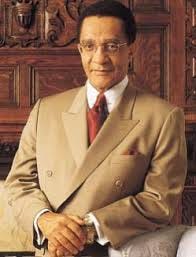
For four decades, Tony Brown sat across from presidents, scholars, activists, and ordinary people, asking the questions mainstream television rarely thought to ask. Through Black Journal and its successor, Tony Brown’s Journal, he built the longest-running Black news and public affairs series in television history. When he died on June 17, 2026, at his home in Newport News, Virginia, at age 93, he left behind nearly 1,000 preserved episodes — one of the most complete televised records of African American thought ever assembled.
From Charleston to Detroit
William Anthony Brown was born April 11, 1933, in Charleston, West Virginia, where he grew up knowing both poverty and segregation. After serving in the U.S. Army from 1953 to 1955, he headed to Detroit’s Wayne State University, earning a bachelor’s degree in sociology in 1959 and a master’s in psychiatric social work in 1961.
Journalism found him in Detroit. In 1962, he joined the Detroit Courier as a drama critic and later rose to city editor. A year later, in June 1963, he helped coordinate the Detroit Walk to Freedom, where some 125,000 people marched with Dr. Martin Luther King Jr. and heard an early version of the speech King would deliver at the March on Washington two months later. In 1968, Brown joined Detroit’s public television station, WTVS, and produced C.P.T., the station’s first program made for Black viewers.
Taking the Helm of Black Journal
Black Journal premiered on National Educational Television on June 12, 1968, created in the aftermath of the urban uprisings of 1967 as programming “for blacks, about blacks.” Under executive producer William Greaves, it won an Emmy in 1969. Brown moved to New York to lead the program, and by 1971 he was its executive producer and frequent host.
Brown pushed the show beyond headlines. Black Journal covered civil rights, Black Power, economics, education, and culture in a magazine format, and it trained Black apprentices in the technical side of television—camera, editing, and production jobs long closed to them. Brown believed that putting Black faces on screen was not enough; Black producers, writers, and executives had to shape the stories too.
That independence carried a price. As PBS stations grew uneasy with the show’s sharp viewpoints, Brown took it to commercial television in 1977 with sponsorship from Pepsi and renamed it Tony Brown’s Journal. In 1982, it returned to PBS, where it ran until 2008. Over the years, Brown estimated he interviewed more than 1,000 guests on subjects from the murder of Emmett Till to AIDS in Black communities.
Educator and Advocate
While running Black Journal, Brown became the founding dean of Howard University’s School of Communications. Decades later, from 2004 to 2009, he served as dean of Hampton University’s Scripps Howard School of Journalism and Communications, shaping generations of Black journalists.
He also used his platform to organize. On September 29, 1980, he led the first Black College Day march in Washington, D.C., rallying thousands to defend historically Black colleges and universities as integration and budget pressures threatened their future. In 1985, he founded the Council for the Economic Development of Black Americans, promoting a “Buy Freedom” message of Black economic self-reliance. His politics drew debate — he joined the Republican Party in 1990 — but his theme of self-help stayed consistent through books like Black Lies, White Lies (1995) and What Mama Taught Me (2004).
Legacy
In 2002, the National Academy of Television Arts and Sciences inducted Brown into its Silver Circle. His greater honor is the archive he left and the journalists he trained. Tony Brown proved that Black audiences deserved serious, independent news on their own terms—and then spent a lifetime making sure it existed.
Sources
Tony Brown (1933– ), BlackPast.org
Tony Brown, Britannica
Tony Brown’s legacy: Shaping Black voices in media, The Washington Informer
Black College Day, Tony Brown’s Journal
A Sense of Commitment and Festivity Marks First Black College Day March, The Washington Post
As a small Substack publication, we could really use your support!
Please enter your email below to support us by subscribing at the free or paid level for less than $10/month.
Independent authors and creative professionals! Please scroll to the “Shameless Plug” at the end to find out about the Pam Speaks 2 You Creative Business Community app for creative branding and marketing.
Today In Black History
In 1884, Black inventor J.W. Reed patented a dough kneader and roller.
In 1961, President J.F. Kennedy appointed Thurgood Marshall to the U.S. Court of Appeals.
In 1979, Lou Brock became baseball’s all-time leading base stealer with 935 stolen bases.
Paid subscribers can always leave questions in the comments or email us.
Please consider becoming a paid subscriber for $10/month or less to access all of the articles and other benefits.



If you are an independent author or creative professional, this is your chance to join the Pam Speaks 2 You Creative Business Community, and there’s an app for that!
The Pam Speaks 2 You Apple/iOS app is live!
The Pam Speaks 2 You Google/Android app is live!
You can also access the Pam Speaks 2 You app on the web!