

Issue #1,084 Thursday, October 8, 2026
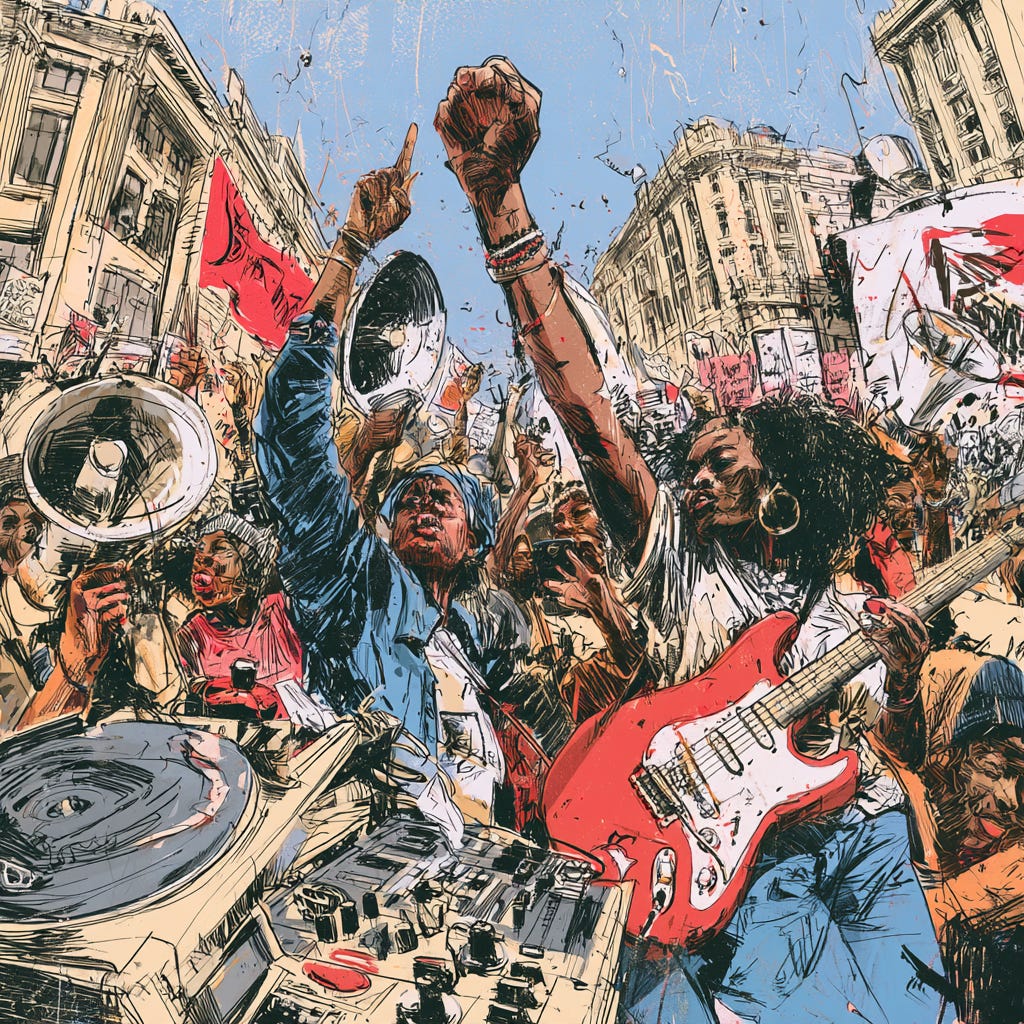
This past weekend, my wife and I attended a jazz concert in Pontiac, billed as a fundraiser for Dr. Abdul El-Sayed, our candidate for Michigan’s next U.S. Senate seat, to fill the seat of retiring U.S. Sen. Gary Peters. It was a great event, standing room only, and the music was fantastic. We saw the event posted on Facebook and decided we couldn't miss it.
But that post drew some interesting reactions. Predictably, some wanted to tear down Abdul. But more than once, I noticed a comment expressing the questionable sentiment that good music shouldn't be polluted or sullied by being associated with anything political.
In other words, can’t those musicians just shut up and perform for our entertainment? Why do they insist on being involved with what’s happening in their community? Don’t they know we only go to concerts to forget about the world's problems?
Kinda reminds me of when right-wing nutjob Laura Ingram told basketball superstar LeBron James to just “shut up and dribble” and stop making political statements. Just be the good trained monkey we pay you to be. Needless to say, Ingram was ignored.
But here’s the thing, just for those who may not be aware. Music isn’t just for the party people. Music has teeth. To quote a song from one of my favorite rap groups, Public Enemy, music has a long history of being used to Fight The Power. Check the lyrics:
As the rhythm designed to bounce
What counts is that the rhymes
Designed to fill your mind
Now that you’ve realized the pride’s arrived
We got to pump the stuff to make us tough
From the heart
It’s a start, a work of art
To revolutionize make a change nothing’s strange
People, people we are the same
No we’re not the same
‘Cause we don’t know the game
What we need is awareness, we can’t get careless
You say what is this?
My beloved lets get down to business
Mental self defensive fitness
Don’t rush the show
You gotta go for what you know
Make everybody see, in order to fight the powers that be
Lemme hear you say
Fight the power
Fight the power
Fight the power
Fight the power
Fight the power
Fight the power
Fight the power
We’ve got to fight the powers that be
Indeed, the history of protest music can be traced back at least as far as slavery, when music was not only a means of survival and a way to emotionally endure horrific conditions, but also to send messages in code about planned escapes and other news in ways that the plantation owners and overseers couldn’t understand or decipher.
Here are some other examples of how music can be such a critical ingredient of protest and protest movements (Source: The Library of Congress):
Abolitionism: An Early American Example
The relationship between political protest and music predates the 1960s by more than a century. American abolitionists used music as part of the campaign against slavery. The Library of Congress identifies numerous anti-slavery hymnals and songbooks published between 1834 and 1856. Abolitionists understood that songs could communicate moral arguments against slavery and encourage people to take action.
One notable example was The Anti-Slavery Harp, which William Wells Brown compiled in 1848. Such publications demonstrate that music was part of the abolitionist movement’s communications infrastructure.
The Civil War
Music played an important role in creating political and military identity during the Civil War. Soldiers and civilians used songs at political rallies, in camps, and elsewhere to reinforce belonging and purpose.
Union-associated songs included “John Brown’s Body,” “Tramp, Tramp, Tramp,” and “Marching Through Georgia.” Confederate supporters used songs such as “Dixie.” The contrasting musical traditions demonstrate how music could help define what people believed they were fighting for.
Women’s Suffrage
The women’s suffrage movement also recognized music as a useful tool for organizing and communication. Suffragists adapted familiar tunes, hymns, and popular songs by giving them new political lyrics. Using melodies that audiences already knew made the new political messages easy to learn and sing.
This established a recurring pattern in protest music: movements often take something familiar and give it a new political meaning.
Labor Movements
The relationship between music and labor organizing is especially strong. During the late nineteenth and early twentieth centuries, workers and union organizers used songs to recruit members, maintain morale on picket lines, communicate grievances, encourage solidarity, and attract public sympathy.
Examples include:
· “Solidarity Forever”
· “Which Side Are You On?”
· “Bread and Roses”
· “I Am a Union Woman”
Music provided labor movements with a common emotional language that complemented speeches, pamphlets, and organizing activities.
African American Spirituals, Gospel, Blues, and Civil Rights
One of the most important American examples is the cultural continuum connecting African American spirituals, gospel, blues, freedom songs, soul, funk, and hip-hop. These traditions are not politically identical, but they share long histories of expressing suffering, resilience, identity, and resistance.
The Civil Rights Movement inherited a musical language that was already deeply embedded in Black American culture. Music therefore became a practical tool for organizing rather than simply a soundtrack to political activity.
The Civil Rights Movement
The relationship between protest and music reached an extraordinary level during the 1950s and 1960s. People sang songs at mass meetings, churches, demonstrations, marches, and in jails. They helped activists stay courageous and united while confronting harassment, intimidation, and violence.
“We Shall Overcome”
“We Shall Overcome” became one of the most recognizable musical symbols of the American Civil Rights Movement. Its origins trace back to African American spiritual and gospel traditions, including Charles Tindley’s “I’ll Overcome Someday.” The song was used repeatedly in the movement because its simple structure allowed large groups to sing together.
The important point is that freedom songs were not merely songs about civil rights. Activists actually used them while conducting civil-rights work. Music became part of the movement’s organizational infrastructure.
The March on Washington
At the 1963 March on Washington, music was integrated directly into the political event. Performers included Mahalia Jackson, Marian Anderson, Bob Dylan, Joan Baez, Peter, Paul, and Mary, and Harry Belafonte. Approximately 250,000 people participated.
Music was not simply entertainment between political speeches. It helped create the demonstration's emotional and cultural environment.
Vietnam and the 1960s
The Vietnam era broadened the connection between music and political activism. Artists including Bob Dylan, Joan Baez, Pete Seeger, Phil Ochs, Nina Simone, and Marvin Gaye addressed war, racism, poverty, inequality, and political conflict.
Important examples include:
· Bob Dylan — “Blowin’ in the Wind”
· Bob Dylan — “Masters of War”
· Pete Seeger — “Where Have All the Flowers Gone?”
· Phil Ochs — “I Ain’t Marching Anymore”
· Marvin Gaye — “What’s Going On”
“What’s Going On” and the Expansion of Protest Music
Marvin Gaye’s 1971 album “What’s Going On” illustrates an important evolution. Rather than functioning primarily as a march song, it used soul music to address war, poverty, racism, environmental concerns, and social conflict.
This shows that protest music didn't have to sound like a traditional protest march. Political expression could be embedded in soul, funk, jazz, rock, and mainstream popular music.
Jazz and Protest
Jazz has also had a substantial relationship with social and political resistance. Examples include Billie Holiday’s “Strange Fruit,” Max Roach’s “Freedom Now Suite,” Charles Mingus’s “Fables of Faubus,” and Nina Simone’s “Mississippi Goddam.”
Jazz could challenge political and social structures not only through lyrics but also through performance, artistic choices, and the music industry's organization. Producer and concert promoter Norman Granz, for example, used his Jazz at the Philharmonic concerts to challenge segregation and racial discrimination.
Reggae and International Protest
Reggae developed in Jamaica amid significant social and political tensions. Artists such as Bob Marley, Peter Tosh, Burning Spear, and Jimmy Cliff addressed colonialism, poverty, political violence, racism, and social inequality.
Bob Marley’s “Get Up, Stand Up” became an internationally recognized protest song. Reggae demonstrates how a musical style itself can become associated with resistance.
South Africa and Apartheid
Music played an important role in opposition to apartheid. Artists including Miriam Makeba, Hugh Masekela, Abdullah Ibrahim, and Johnny Clegg helped bring South African racial and political issues to international audiences.
Music and dance accompanied liberation movements and served as vehicles for cultural identity, resistance and international communication.
Latin America and Nueva Canción
The Nueva Canción movement became especially important in Latin America during the 1960s and 1970s. Drawing on folk traditions, artists addressed poverty, workers’ rights, indigenous rights, colonialism, political repression, and social justice.
The movement became particularly prominent in countries including Chile and Argentina and showed how traditional musical forms could adapt to contemporary political struggles.
Music is the heartbeat of revolution.
If you like us, REALLY like us, please click the little heart “Like” button at the top of this post!

Buttons:
Heart: Like Bubble: Comment Arrow Up: Share Arrows Circle: Restack
If you like us, REALLY like us, please click the “Like” button at the top of this post!
Your “Likes” mean a LOT to us! We appreciate your support!
Buy Pam a cup of Colombian Coffee!
Engage with us and our posts on Substack Notes, where we publish new content almost daily.
We Are Speaking is a reader-supported publication. To receive new posts and support our work, consider subscribing for free or paid access.
Follow Pam on Bluesky, the best “X” alternative.
Follow Keith on Bluesky, the best “X alternative.
Independent Authors and Creative Professionals: Check out my valuable books and courses on Branding and Marketing just for you via the Pam Speaks 2 You app.

