

Special Edition Tuesday, November 10, 2026
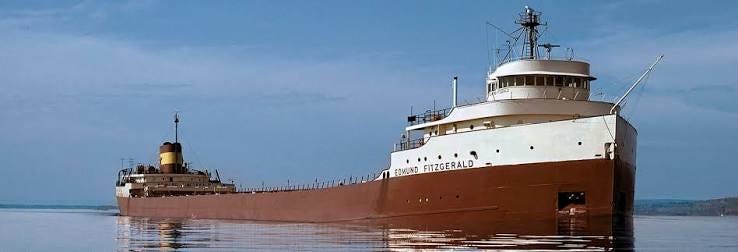
On November 10, 1975, the freighter Edmund Fitzgerald disappeared beneath Lake Superior during a violent storm. All 29 men aboard were lost. The ship’s sudden loss became one of the Great Lakes’ enduring mysteries—and, a year later, the subject of Gordon Lightfoot’s haunting ballad.
A ship built for the lakes
Launched in 1958, the Edmund Fitzgerald was one of the largest vessels on the Great Lakes, measuring 729 feet long. She carried iron ore pellets from mines around Lake Superior to steel mills farther east. For nearly two decades, the ship was a familiar and successful presence on the lakes.
On her final voyage, she left Superior, Wisconsin, on November 9, bound for a steel mill near Detroit with a full cargo of taconite. The next day, a powerful storm swept across Lake Superior. Winds rose, visibility collapsed, and waves battered ships on the lake.
The last hours
The Fitzgerald sailed with the Arthur M. Anderson, another freighter. Radio messages between the ships and shore tell part of the story: the Fitzgerald reported damage to two vents and a list, and said it was taking on water. Later, Captain Ernest McSorley told the Anderson that the ship was holding its own.
Then, shortly after 7 p.m., the Fitzgerald vanished from radar. There was no distress call. The Anderson searched through the storm, but found no survivors. The wreck was later located on the lakebed, broken into two main sections.
The cause of the sinking has never been settled. The Coast Guard’s inquiry considered possibilities including flooding, hatch-cover problems, and damage from grounding on a shoal. The wreck and the storm were real; the exact sequence of failures remains uncertain. That uncertainty is part of why the loss still invites questions, but it should not be mistaken for evidence of a single definitive explanation.
A song becomes a memorial

In 1976, Gordon Lightfoot released “The Wreck of the Edmund Fitzgerald.” He shaped the disaster into a narrative ballad, carrying listeners through the storm and the ship’s final hours. The song is a work of art, not a transcript: some details were simplified or changed, and the surviving records do not support every lyric as literal fact.
But its central act was remembrance. Lightfoot gave listeners a way to hold the names of the 29 crew members in mind, long after the headlines faded. His song helped turn a shipping disaster into a shared memorial.
Listen: Gordon Lightfoot — “Wreck Of The Edmund Fitzgerald” (official audio)
Remembering the crew
Every November, the sinking is recalled not only as a maritime tragedy but as the loss of 29 people who left home to do dangerous, ordinary work. The mystery of exactly how the ship went down may remain, but one thing is certain: the Fitzgerald did not return, and its crew did not come home.
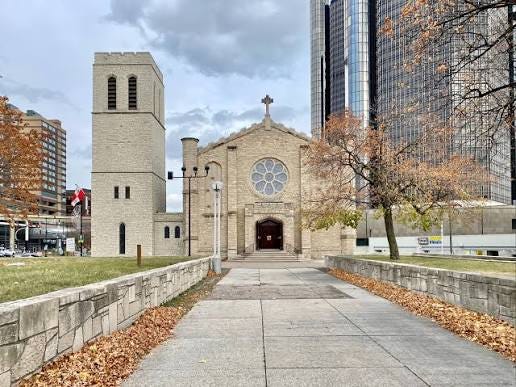
Every year on November 10, 29 bells are rung at the historic Detroit Mariners’ Anglican Church near the Detroit River to honor the 29 lives lost on the Edmund Fitzgerald.
Lightfoot’s song endures because it refuses to let that fact become just a statistic. It asks us to remember the ship, the storm, and the men aboard.